
Most of the conversation about quantum computing focuses on hardware benchmarks. Qubit count. Error rates. Coherence times. These are real problems and the field is making genuine progress on them.
But there is a quieter problem that does not get enough attention: integration. Specifically, what it actually takes to run a quantum system inside a working HPC environment, alongside classical compute, under the same scheduler, with the same authentication and user management, subject to the same operational constraints.
HPC centers are moving from evaluating quantum systems to operating them.
Integration determines whether those systems become usable infrastructure.
This is where most deployments get complicated. Not because the hardware fails, but because the infrastructure around it was not built to accommodate it.
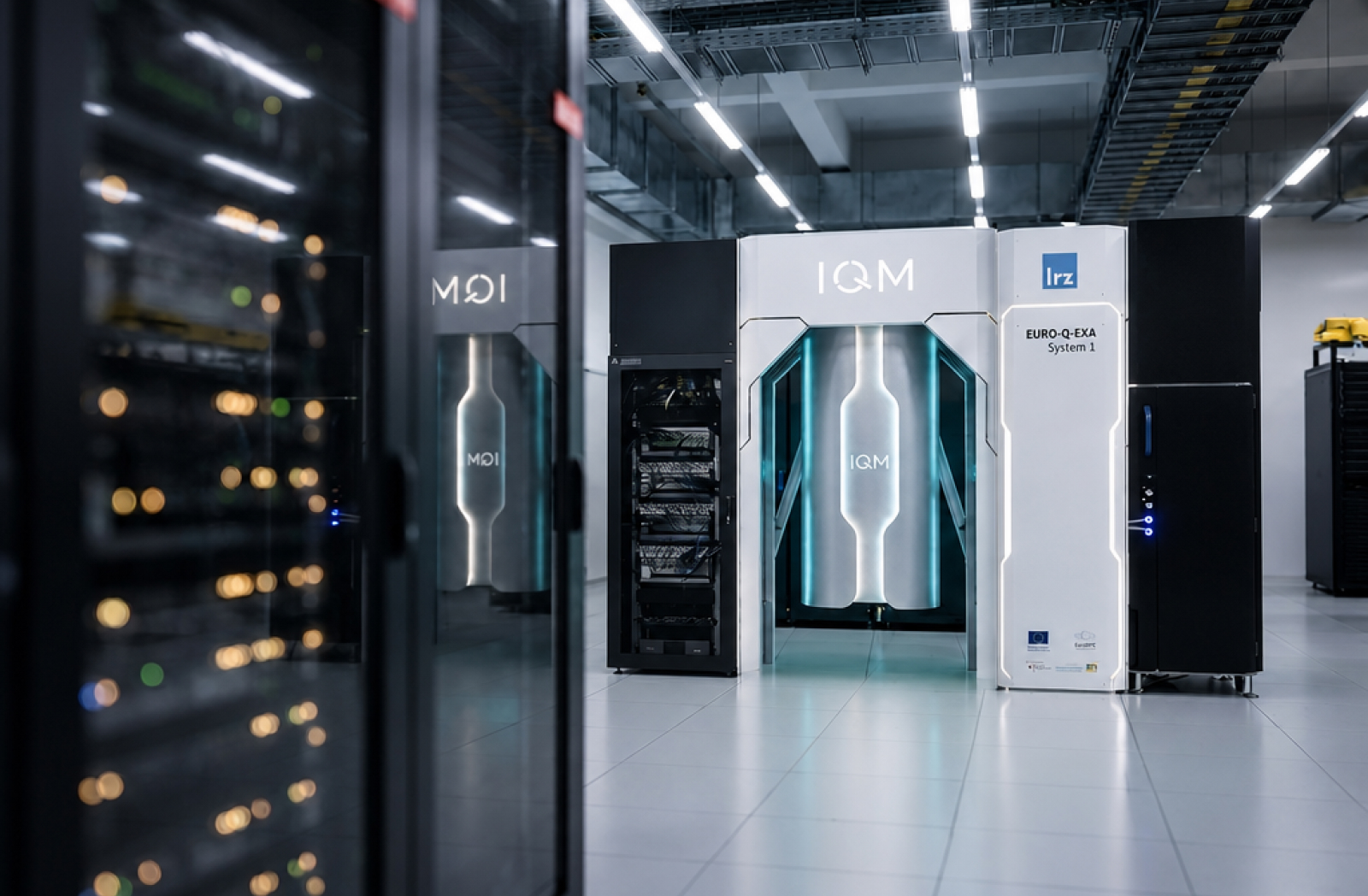
Every quantum system arrives with its own interface, its own execution model, and its own set of operational requirements. For an HPC center running multiple systems from multiple providers, this means building and maintaining a separate integration for each one. Custom adapters between quantum APIs and HPC schedulers. Inconsistent authentication across access paths. Monitoring and accounting implemented differently per system.
These integrations work at first. The problems emerge as the environment grows. Scheduling conflicts arise when jobs are submitted through both HPC schedulers and external quantum access points, requiring coordination across systems. System updates require changes across multiple integration layers simultaneously. What started as a manageable set of custom connections becomes an ongoing engineering effort with real operational risk.
This is the situation facing HPC centers that are serious about running hybrid quantum-classical workloads at scale.
“Operational complexity increases when workloads are scheduled across multiple layers and require consistent authentication and coordination between systems.” Dr. Luigi Iapichino, Group Lead Quantum User Enablement and Applications at LRZ
Leibniz Supercomputing Centre operates one of Europe’s most important HPC environments. They run multiple quantum systems from multiple providers and needed a consistent way to manage all of them, without rebuilding their integration layer every time a new system came online.
To address this, LRZ and other Munich Quantum Valley (MQV) partners have contributed to the development of the Munich Quantum Software Stack (MQSS) and of QDMI, which is a core component of the IQM Integration Service.
Building further upon the development on QDMI done by LRZ and other MQV partners, and profiting from the experience in the interaction with partner HPC centres, IQM has developed a service which combines three components into a unified integration model:
Together, these components provide a complete integration stack.
The practical effect is that quantum resources now behave like any other resource in the HPC environment. Jobs are submitted and managed through existing infrastructure. Authentication is consistent. Scheduling works across classical and quantum components within a single execution model.
The integration service provides the deployment and operational layer. It ensures that the integration is correctly implemented within the HPC environment, aligned with scheduler configuration, user management, and system policies. This addresses the practical challenges identified by LRZ:
“The challenge is coordinating scheduling across systems while maintaining consistent authentication and control over workloads.” Dr. Luigi Iapichino
By combining interface standardization, system-level integration, and deployment support, the HPC Integration Service provides a complete solution. Instead of developing custom integrations, HPC centres want to deploy a reusable integration layer designed for HPC environments. This reduces engineering overhead, improves system stability, and enables hybrid quantum–classical workloads to operate within existing workflows.
IQM is an important partner for HPC centres like LRZ because it delivers the integration model as a deployable capability, including interface support, scheduler integration, and operational alignment with HPC infrastructure. The alignment between QDMI, the system architecture, and the deployment service enables a predictable and scalable approach to integration.
“Alignment between the system architecture and the integration framework enables a more efficient and predictable deployment.” Dr. Luigi Iapichino
Before this approach, integration required system-specific adapters and coordination across multiple layers. With the integration service, quantum resources operate within the same execution model as classical workloads.
This establishes a consistent model for integrating quantum systems into HPC infrastructure, supporting both current operations and future expansion.
The LRZ deployment is one data point. But the underlying challenge is common to any HPC center adding quantum to its infrastructure.
QDMI establishes a common interface that allows HPC centers to integrate once and add new systems without rebuilding their integration layer. Instead of building system-specific integrations for every quantum provider, HPC environments integrate once against a common interface. New systems come online without requiring new integration work from scratch. The operational burden stays manageable as the environment grows.
This is how quantum computing moves from experimental to operational inside HPC. Not through a single hardware breakthrough, but through the patient work of building infrastructure that is stable, interoperable, and built to last.
The hardware is getting better. The integration layer needed to catch up. That is what we are building.

Emilia Stuart is a content strategist and storyteller at IQM Quantum Computers, specializing in translating complex quantum computing concepts into engaging narratives. With a background in research and tech marketing, she understands potential customers and crafts stories that resonate. Emilia’s passion is making intricate technologies accessible to diverse audiences.
Search faster—hit Enter instead of clicking.
Click to expand