
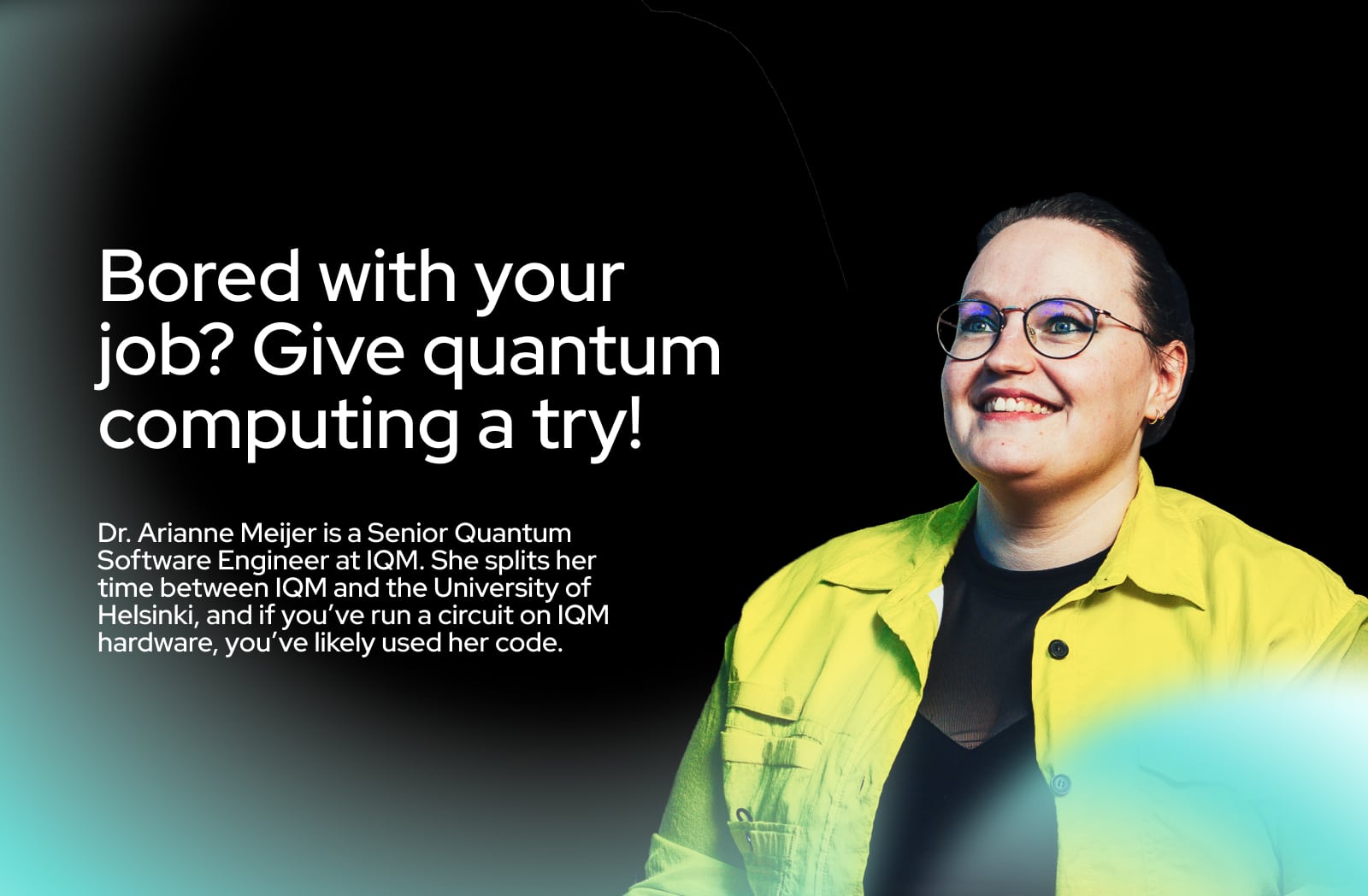
Dr. Arianne Meijer is a Senior Quantum Software Engineer at IQM. She splits her time between IQM and the University of Helsinki, and if you’ve run a circuit on IQM hardware, you’ve likely used her code.
I get bored easily.
That’s usually where things start.
There’s a Dutch expression ”niet geschoten is altijd mis” — a shot not taken is always missed — that describes how I approach life. As a result, I tend to end up slightly ahead of things. Not because I plan for it, but because I go looking for problems that are challenging and safe enough to fail.
That’s more or less how I ended up in quantum.
My background is in computer science and AI. I did both because I didn’t want to choose between abstract reasoning and automating things. During my studies, I ran out of interesting courses and picked up quantum computation almost incidentally. It looked unfamiliar, slightly uncomfortable, and just about solvable with some effort.
That should keep my interest for a while.
“I don’t try to think outside the box—I work from the assumption that there is no box.”
During my master’s, that mindset led me to apply a genetic algorithm to a compiler problem I couldn’t solve conventionally. It ended up outperforming the world’s best compiler on a specific task. Doing weird things works.
That’s usually where the interesting problems are: solvable, but not yet solved. Close to what comes next. The known unknowns. Difficult, but still tractable.
Quantum is full of those. The mathematics is consistent. What breaks is your intuition. Once you let go of the mental models you bring from classical systems, the space of problems — and solutions — opens up quite quickly.
If you’ve run a circuit on IQM hardware through Qiskit or Cirq, you’ve used my code.
I work on the Python-layer integration for IQM’s quantum computers. A large part of that is the MOVE transpiler for the Star-architecture devices, which handles the central resonator under the hood, so most users don’t have to think about it at all.
From the outside, you can write your circuit as if that complexity doesn’t exist. But the abstraction is optional.
“I hide the complexity by default, but I don’t take it away.”
The compiler that translates circuits into pulse-level instructions is fully open source. You can inspect it, understand it, and build on top of it, which is still relatively uncommon among hardware providers.
If you want to work closer to the hardware, you can — including removing the safety mechanisms. For example, the system normally prevents you from exciting both the qubit and the resonator at the same time, because that leads to state leakage. Usually, that’s not what you want. Sometimes it is. So we allow users to turn those checks off and interact directly with that behaviour.
That’s roughly 40% of my work.
The distinction is simple: in academia, you’re selling papers. In industry, you’re building systems.
In academia, novelty is enough. The work doesn’t have to be immediately useful. In industry, it has to run, integrate, and scale. Often, the less exciting solution is the correct one. A lot of the important bits get lost between theory and implementation, that’s why I keep both.
At IQM, I work with real machines and real constraints — the details that don’t make it into papers, but decide whether something actually works. At the university, I focus on ideas that might take years to matter.
That difference carries into how I work with people. At Helsinki, I do research, supervise PhD students, and teach quantum programming. At IQM, I write software, organize technical sessions, and supervise master’s work.
Same principle in both: don’t let understanding stop at the abstraction layer.
I have ADHD, which is both useful and inconvenient.
It’s part of why I tend to pick things that are slightly outside the obvious path, and also why staying focused when multiple things compete for attention can be difficult.
What helps is structure. Clear tasks, short feedback loops, and protected focus time make a significant difference. The rest is mostly about working with how your brain operates rather than against it.
“A lot of ADHD accommodations are just generally good life management practices.”
The Espoo software team is flexible in that sense. People work differently — remotely, at different hours, sometimes in bursts — and it works because coordination is based on communication rather than rigid structure.
That’s usually enough.
If you’re working on quantum today, there’s a good chance your name will be part of how this field is remembered in a few years.
This is still a pioneer phase, with only a small number of people shaping the field. The direction is becoming clearer, but most of the work still lies ahead. We can borrow from classical computing, but not everything translates, especially on the hardware side.
“It’s mostly a matter of doing the work.”
Which means what you build now doesn’t just fit into a system, it helps define it.
Give quantum a heartbeat.
Explore opportunities to join our team.
Search faster—hit Enter instead of clicking.
Click to expand