

Sign-ups exceeded our expectations. That level of interest from the community underlines why initiatives like this matter, and it motivates us to make the next edition even bigger.
The winners were announced at the Superconducting Qubits and Algorithms (SQA) Conference in Gothenburg, in front of one of the most esteemed audiences in the field. Being able to share this moment with that crowd of researchers was an honor.
Our judges came away with a consistent set of impressions. The overall quality of applications was high, the range of topics was diverse, and notably, most submissions arrived with ready-to-run code examples.
The research directions covered many different fields, including quantum chemistry, simulation, and optimization approaches, proposals that push the quantum ecosystem toward future applications. We were also excited to see abstracts on low-level manipulations of superconducting qubits, work that helps us find new avenues to improve QPU performance.
That diversity carried through to the eight proposals that made it to the second round, where applicants presented their research directly to us. Quantum simulation and many-body physics were strongly represented, with work spanning ground-state preparation, lattice gauge theories, and the generation of phase diagrams. Alongside these were hybrid quantum-classical decomposition methods for industrially relevant optimization problems, and a protein structure prediction proposal built on qubit-efficient encodings. Other applicants tackled questions close to our hardware: application-level benchmarking and certification that goes beyond one- and two-qubit gate fidelities, and geometric pulse design aimed directly at improving gate performance on our devices.
Across four rounds of evaluation, from abstract to hardware execution, these researchers stood out for the quality of their proposals, the strength of their results, and the scalability of their ideas.
The final round of judging was carried out by Juha Vartiainen (Chief Global Affairs Officer), Juha Hassel (VP of Quantum Technologies), Frank Deppe (Principal Quantum Architect) and Inés de Vega (Chief Scientific Officer).
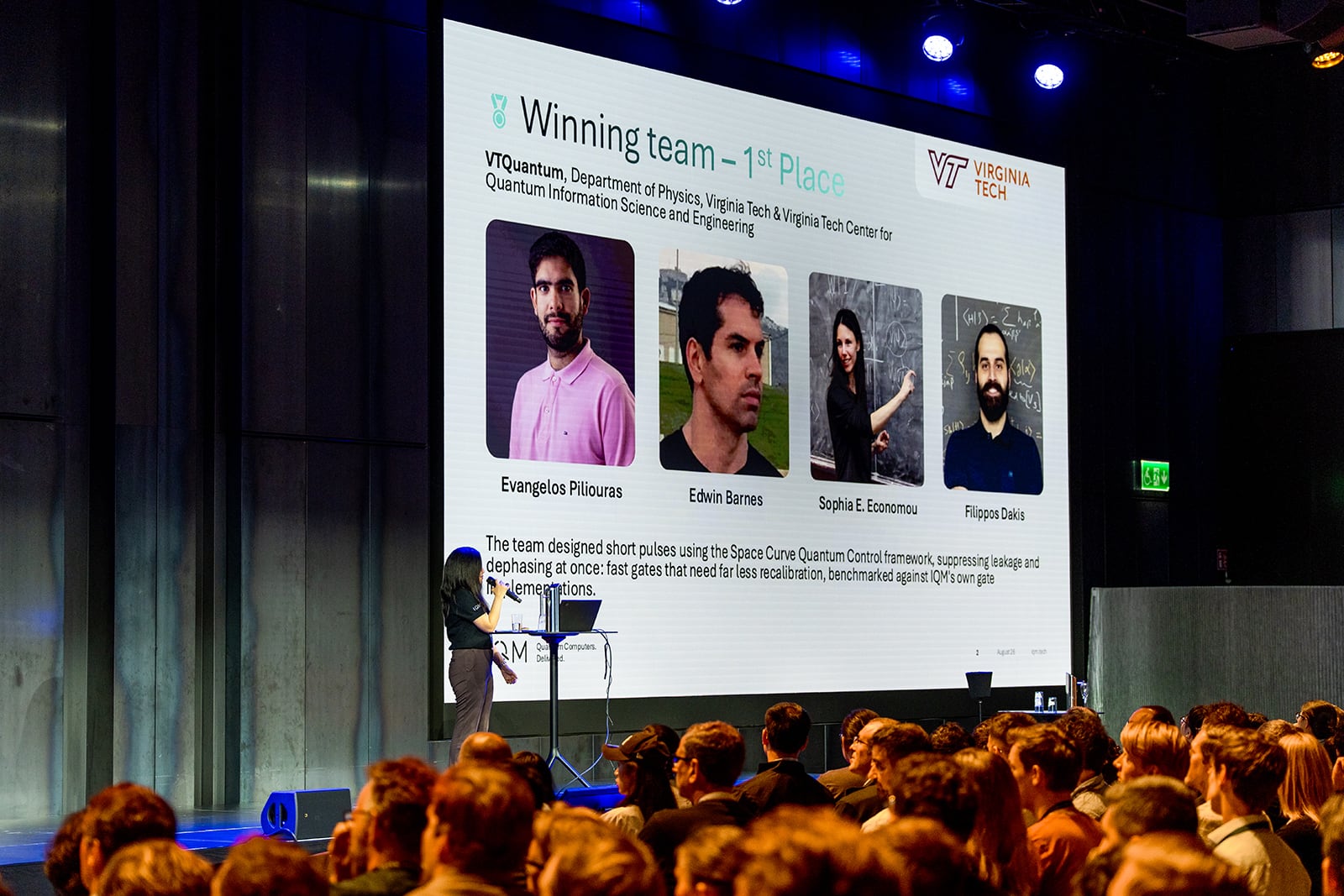
First Place: VTQuantum, Department of Physics, Virginia Tech, and Virginia Tech Center for Quantum Information Science and Engineering
The winning team designed short pulses based on the Space Curve Quantum Control framework that suppress leakage and dephasing at the same time, promising fast gates that need far less recalibration. This proposal is ideally suited to IQM’s hardware: with extensive benchmarks against IQM’s gate implementations, the team built a clear, evidence-backed vision for improving superconducting hardware.
Awarded €10,000 and 12 months of IQM Resonance access.
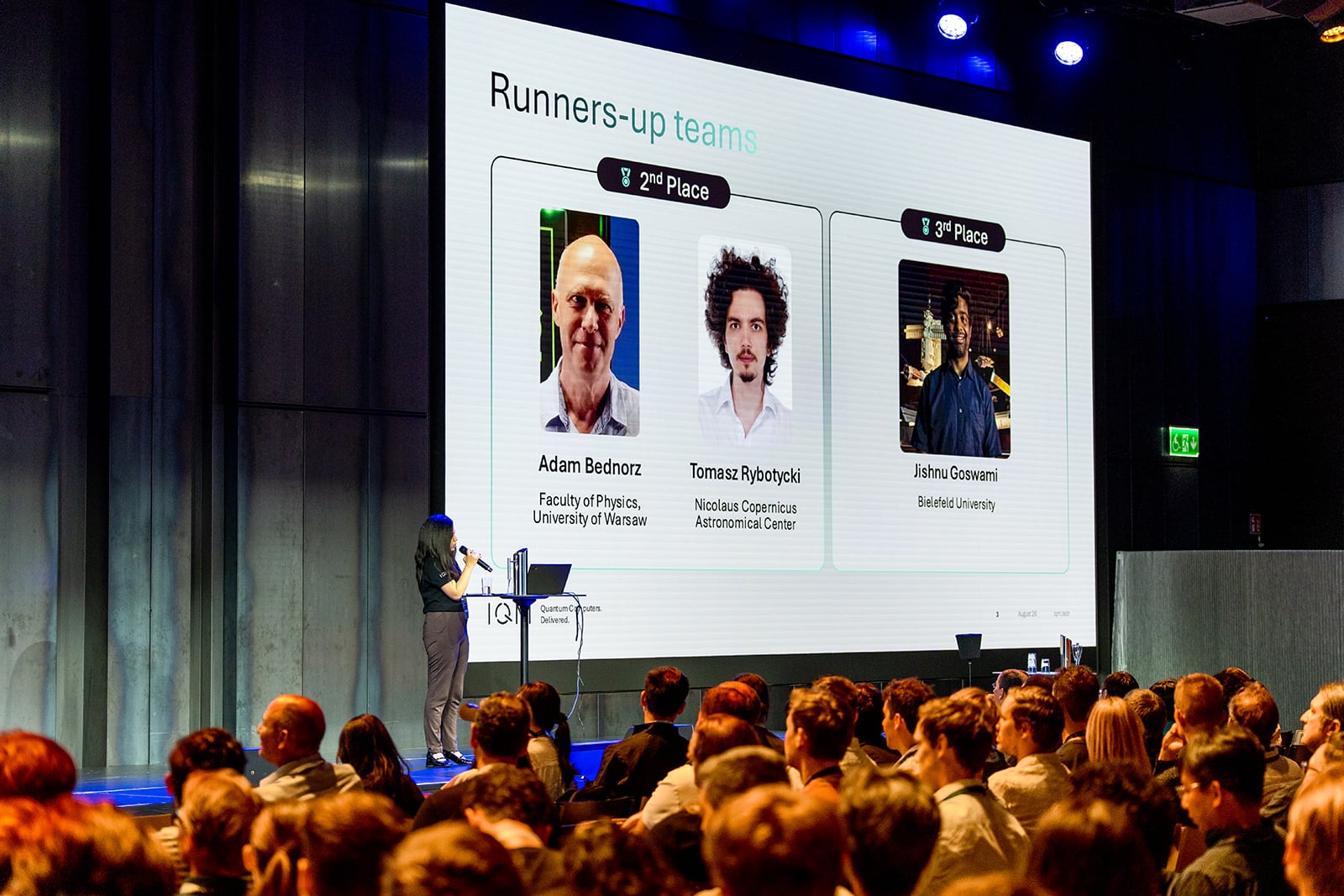
Second Place: Tomasz Rybotycki, Nicolaus Copernicus Astronomical Center, and Adam Bednorz, Faculty of Physics, University of Warsaw
This team used pulse-level control to implement genuinely weak measurements, turning Leggett-Garg violations into a scalable benchmark for device quality.
Awarded 6 months of IQM Resonance access.
Third Place: Jishnu Goswami, Bielefeld University
This proposal uses the exact Gauss-law constraint of a Z₂ lattice gauge theory as a built-in error syndrome, testing how much true dynamics can be recovered from noisy hardware data.
Awarded 6 months of IQM Resonance access.
Production Quantum is about building quantum computers that hold up under real workloads, real customers, and real deadlines. That takes more than hardware. It takes an ecosystem of researchers willing to test ideas against actual devices, share results openly, and push on the specific problems that stand between today’s QPUs and tomorrow’s applications.
This year’s proposals are a good example of what that ecosystem produces. Pulse designs benchmarked directly against our gate implementations. Lattice gauge theory results tested on real, noisy hardware rather than simulated in the abstract. Benchmarking methods built to certify device quality beyond the usual one- and two-qubit metrics. Work like this feeds straight back into how we build and improve our systems, and it only happens when researchers outside IQM have the access and the incentive to engage with our hardware directly.
That is the point of the IQM Research Award. Every proposal we receive, and every winning idea we get to support with compute time and funding, strengthens the ecosystem that Production Quantum depends on.
To everyone who signed up, submitted a proposal, and ran experiments on our hardware during the competition: thank you. The IQM Research Award exists because of researchers like you, and this year’s results have set a high bar for what comes next. Stay tuned for the results from these experiments and for the opening of the 2027 application period for this award.