
In 2027, the largest superconducting quantum computer built in Europe will run in Finland: a 300-qubit IQM Radiance system, operated by VTT and integrated into the national supercomputing infrastructure, with the first 150-qubit stage arriving late 2026. The announcement is the visible part. What matters more for any institution looking to replicate Finland’s success is the five-year co-development model behind it.
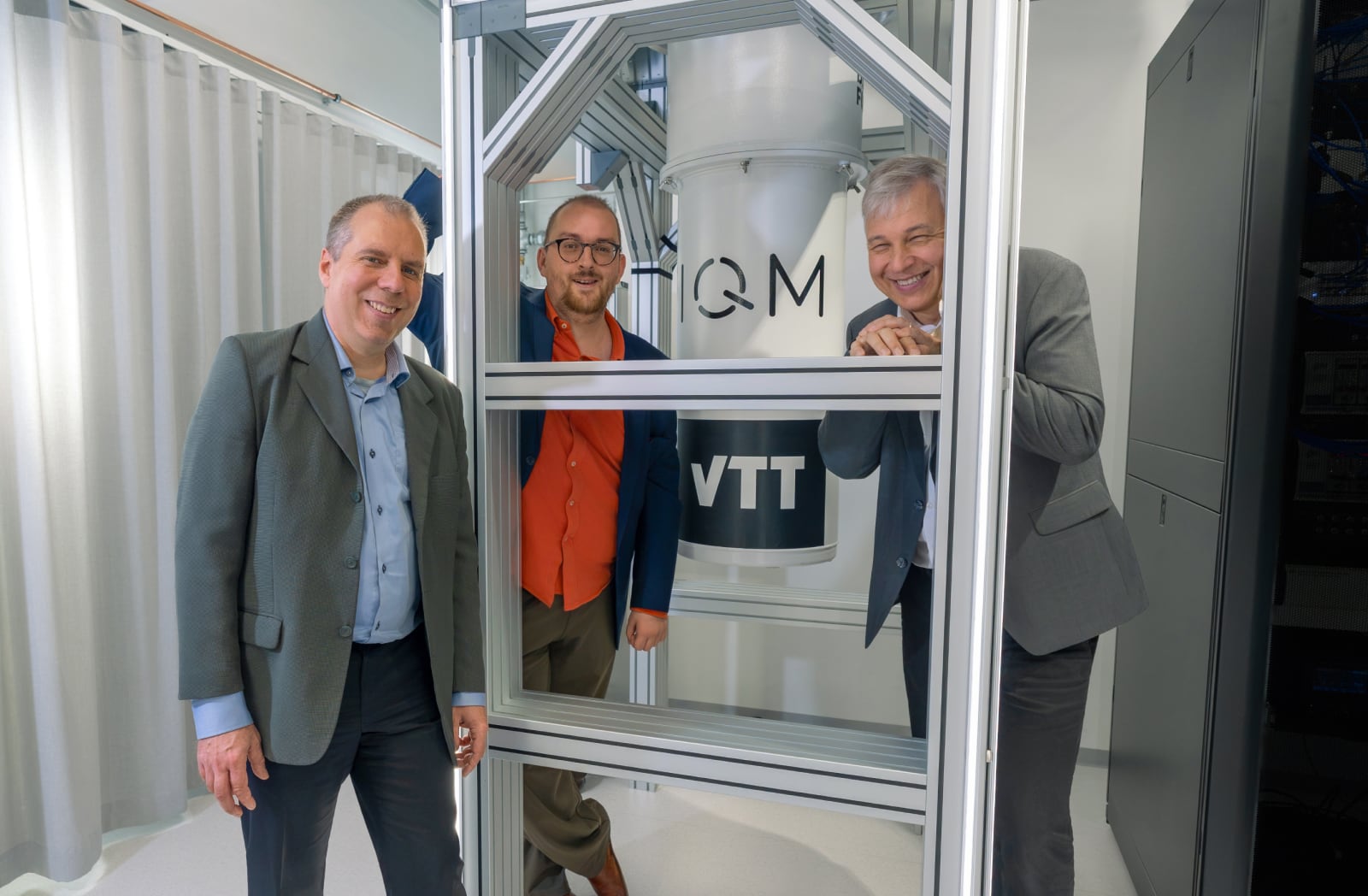
Juha Hassel (left), Jorden Senior and Tomi Mattila with VTT’s first quantum computer
IQM was founded in 2018, spinning out of the shared research environment of Aalto University and VTT, a research organization owned by the Finnish state. From the first system onward, VTT has been a co-development partner, aligning research topics with IQM and feeding operational experience straight back into the next generation of hardware. Jorden Senior, who leads VTT’s quantum hardware team, puts the working relationship plainly: “We know each other’s labs, people and quality standards, so we move fast, and we are candid with each other.”
The mandates are complementary. IQM builds and delivers quantum computers, with more than 20 systems deployed across 10 countries. VTT de-risks the long-horizon side: it operates Finland’s national quantum infrastructure, pursues the strategic, higher-risk research that no single company would fund alone, and opens the hardware to researchers and companies through its open access program.
Quantum computers aren’t plug-and-play systems yet. Jorden explains: “Since our first co-development project with IQM, we’ve learned that real expertise means having access to every layer of the stack, from control electronics through qubit control and error mitigation to the algorithms and services on top. Having our own on-premises systems gives VTT a level of access no cloud-based quantum computer can offer, and enables us to work with the machine’s individual characteristics rather than around them. That’s how you build the capability to innovate across the whole system, all the way down to how you submit a job to it.”
Juha Hassel, who leads quantum technology at IQM, traces the effect back to the company’s earliest days: delivering for a demanding, well-informed partner gave IQM the discipline of a concrete roadmap from the start. He still remembers 2019, tuning up the very first qubits and building the company’s first cryostat in the back room of IQM’s then office. That the same partnership now spans a program measured in hundreds of qubits shows how far the model carries.
Tomi Riipinen, whose team at IQM builds the quantum computer around the processor, points to the speed of learning: each delivery generates immediate feedback, and each round of feedback generates ideas both organizations can use. Pulse-level access, developed through weekly working sessions between the teams, is one example, and it shows how the model scales beyond a single partnership: capabilities proven with VTT become part of IQM’s transparent, open stack, available to every customer who wants to work at that depth.
Since 2021, VTT has operated a series of IQM systems, each generation extending both qubit count and what researchers can do with the hardware. The first 5-qubit machine gave researchers hands-on access to superconducting quantum hardware. In 2022, it was connected to CSC’s LUMI supercomputer, creating one of the first hybrid quantum-HPC environments in Europe. The system scaled through 20 and 50 qubits, and the 300-qubit program now follows.
Each step compounded on the last, in research output, in operational expertise, and in the depth of the ecosystem around the hardware. Companies and universities using the systems through VTT’s open access program built their own capability in parallel, and the infrastructure keeps producing companies. Between 2022 and 2025, 63 unique projects made use of the national FiQCI infrastructure that VTT operates with CSC and Aalto University, consuming over 5,200 QPU-hours and producing 18 publications and posters alongside 15 vetted use cases. More than 300 people went through FiQCI’s training program over the same period, building a pipeline of researchers and companies who know how to put the hardware to work.
Arctic Instruments, which developed parametric amplifiers for the early systems, is now a leading supplier of superconducting microwave amplifiers, and SemiQon is advancing silicon-based qubits. Both are VTT spinouts. An independent ranking placed the Helsinki region second in the world among quantum clusters, and first in the European Union.
The 300-qubit system consists of two 150-qubit processors operating side by side, with fast classical connectivity between them. That design points at two of the field’s central questions.
The first is quantum error correction. Moving from today’s noisy physical qubits to the reliable logical qubits that broad industrial utility depends on requires hardware in the hundreds-of-qubits range, plus the control, decoding, and algorithmic work to run on it. The 300-qubit system gives Finland, and the researchers and companies who access it, a platform to develop that capability on their own machine and on their own schedule.
The second is scaling itself. Two coupled processors are a concrete starting point for distributed quantum computing, the path by which quantum systems eventually grow the way classical data centers did, unit by unit. And because the machine sits inside Finland’s supercomputing environment alongside LUMI, it extends the hybrid quantum-classical workflows VTT and IQM have run together since the first 5-qubit system. A quantum processor works as an accelerator within a larger classical pipeline, much as GPUs do today, and the applications closest to practical value, in areas like materials science and quantum chemistry, depend on exactly that model.
VTT is keeping the system broadly accessible. Qualifying companies and universities can apply for computing time through the open access program, whatever stage of their quantum journey they are at.
The co-development loop is how IQM works with every customer: operational feedback from deployed systems shapes the roadmap, and the customer and end users raise the bar for what the next generation of IQM products must do. What VTT’s five generations of hardware taught both organizations, in HPC integration, calibration, system operation, and software, is embedded in the systems IQM delivers everywhere, from LRZ in Germany, which has bought twice, to CINECA in Italy and Oak Ridge in the United States.
The staged path is equally transferable. VTT started at 5 qubits, and the point was never the number. It was that capability, expertise, and an ecosystem grew around each machine before the next one arrived. An institution starting today can enter at its own scale, from an IQM Spark system for building first in-house competence up to research systems integrated with national HPC infrastructure, with the same upgrade path and the same feedback relationship. Every new customer joins the loop that makes the next system better.
What Finland has built is an operational ecosystem where hardware development, research access, HPC integration, talent, and commercial spinouts reinforce each other. As Tomi at IQM puts it, it was built from the beginning as a business ecosystem: systems are sold, services are sold, and one organization’s success pulls the others up.
This is Production Quantum: quantum systems institutions own, operate, and build on. When you own the system, the machine, the data, and the IP stay yours. When your team operates it, the expertise accumulates in your team. Build on it, and each hardware generation compounds what the last one taught you. Access expires. Ownership compounds.
Jorden describes the division of labor in the current program simply: “IQM focuses on delivering 300, and VTT focuses on what comes after. We de-risk each other that way.” And Tomi, a Principal Scientist in VTT’s quantum hardware team, has a clear picture of what success would look like by 2030: previously inaccessible, truly usable simulation results, based on a hundred logical qubits with error levels well below one part per million.
That is what five years of co-development looks like in practice. The 300-qubit system is its most significant step yet, and the model behind it is open to any institution ready to start building.

Emilia Stuart is a content strategist and storyteller at IQM Quantum Computers, specializing in translating complex quantum computing concepts into engaging narratives. With a background in research and tech marketing, she understands potential customers and crafts stories that resonate. Emilia’s passion is making intricate technologies accessible to diverse audiences.
Search faster—hit Enter instead of clicking.
Click to expand