
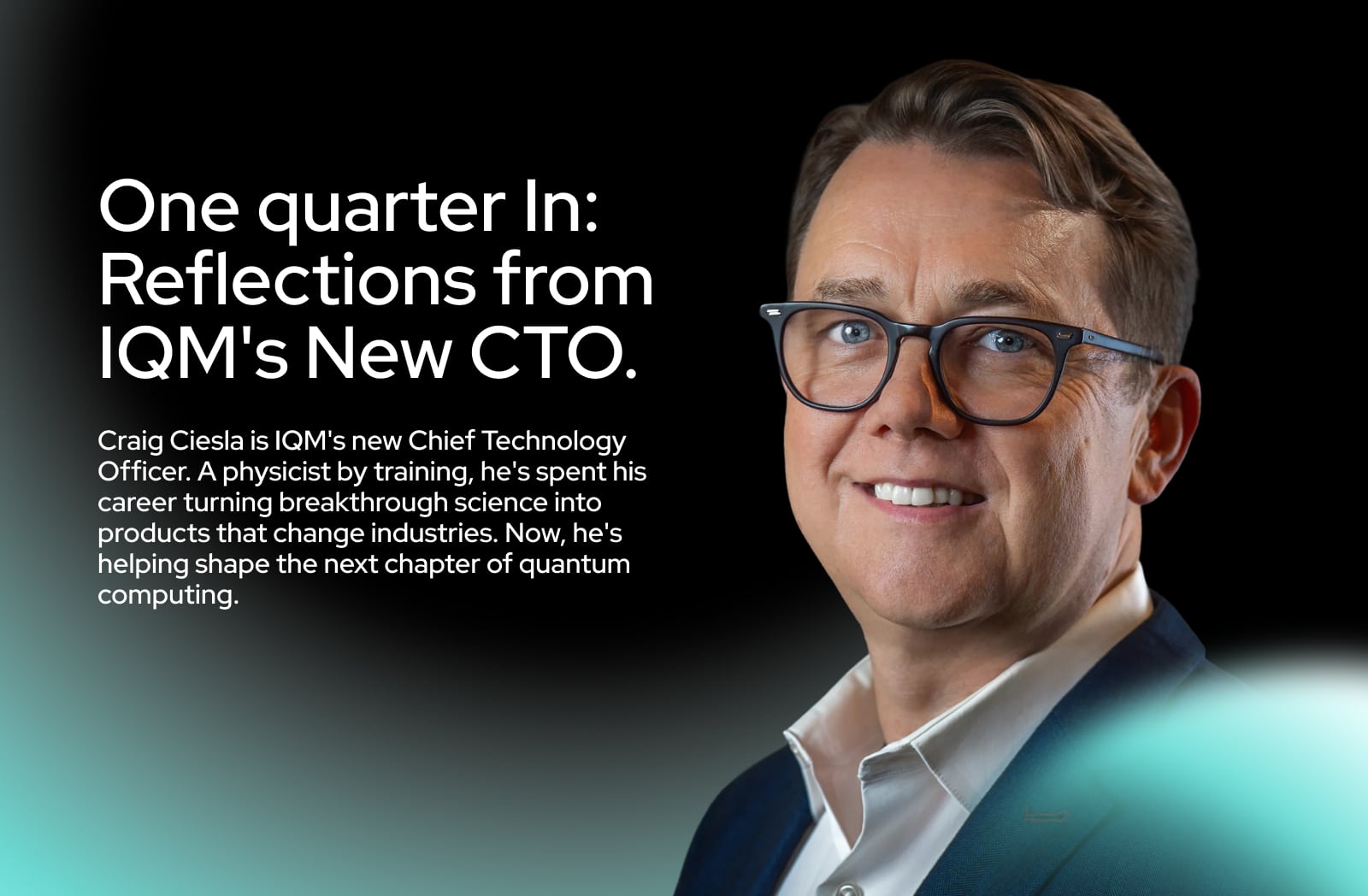
Craig Ciesla is IQM’s new Chief Technology Officer. A physicist by training, he’s spent his career turning breakthrough science into products that change industries. Now, he’s helping shape the next chapter of quantum computing.
When I started my PhD in physics, quantum computing was little more than an academic thought experiment.
It was the kind of idea researchers discussed on whiteboards. Fascinating. Groundbreaking. But still far from reality.
Today, I’m sitting in IQM’s headquarters in Espoo, helping shape the next generation of quantum computers that are already being delivered to customers around the world.
That journey—from possibility to product—is what drew me here.
I’ve spent my career working at the intersection of complex technology and real-world impact, from fibre-optic communications to life sciences. What I’ve always found most interesting isn’t the idea in the lab. It’s the moment the idea leaves it, finds its customers and starts solving real problems.
Joining IQM wasn’t just about joining another deep-tech company. It was about the timing. For decades, quantum computing was driven by scientific possibility. Today, that possibility is becoming reality: many systems have been built. Customers are already using them.
“The challenge now isn’t simply proving the technology works, it’s scaling it. Building the next generations of quantum computers while continuing to push the boundaries of science and engineering.”
Those are the kinds of problems I’ve always been drawn to.
What immediately stood out at IQM was its ambition.
We’re not building just one component of a quantum computer.
We’re building the entire stack—from hardware and chips to software and the applications enabled by quantum computers.
That’s an incredibly ambitious undertaking.
But it’s also what makes IQM unique. When you build the whole system, you don’t optimise individual parts. You solve the customer’s problem as a whole.
I’ve joked that I’ve met more physicists in the past four weeks than I did during my entire PhD. Everywhere you turn at IQM, you’re surrounded by people who have dedicated their careers to advancing quantum computing.
But what impressed me even more than the scientific excellence was the determination. People here aren’t satisfied with publishing great research; they’re determined to build the technology that defines the future of the field. That combination is rare.
People often assume a CTO’s job is to arrive with all the answers. I don’t see it that way.
In my first month, the thing I’ve done most is ask questions because understanding always comes before direction. The team has already achieved something remarkable. My role is to help remove the obstacles that slow exceptional people down: sometimes by creating more clarity around priorities, sometimes by making decisions faster, sometimes by empowering teams to make decisions closer to where the expertise already lives.
Every breakthrough I’ve seen in my career has ultimately come down to people. Brilliant ideas don’t become products without brilliant teams around them. Teams that trust each other, understand not only what they’re doing but why, and feel energised by the work.
Quantum computing adds one more dimension to that. We’re delivering products today, but we’re also still discovering what’s possible tomorrow. And we’re doing both at an incredible pace, with rapid innovation and major leaps in performance constantly redefining what’s possible. Those two worlds have to coexist: pushing the boundaries of tomorrow while delivering on the promises we make today.
An experiment that doesn’t give you the outcome you hoped for isn’t a failure; it’s information, it’s a learning.
“The environments that keep producing breakthroughs are those where people feel safe to experiment, challenge assumptions and take scientific risks that move both the product and its roadmap forward.”
Finding the balance between exploration and execution will be one of the defining questions for IQM in the years ahead. It’s also one of the things that makes the job interesting.
Outside work, my curiosity doesn’t really switch off.
My wife and I first met while studying in Scotland before moving to California more than twenty-five years ago. Today our family stretches across three countries. Our son is beginning a master’s in neuroscience in London, our daughter is studying business in Oregon, and this summer I’ve started another adventure by relocating to Finland.
Whenever we’re together, you’ll usually find us travelling, hiking or at a music festival.
One of our favourite family traditions is combining a few days at Outside Lands in San Francisco with some time in the mountains around Lake Tahoe. It’s the perfect mix of live music, nature and quality time together.
Whether it’s exploring a new place, discovering new music or working with a team to solve difficult engineering problems, I’ve always been driven by curiosity.
Joining IQM felt like a natural continuation of that journey.
Because curiosity is everywhere here.
Search faster—hit Enter instead of clicking.
Click to expand