
I didn’t always plan to land in quantum computing.
I studied physics because I enjoyed maths and science and wanted to do something difficult, and hoped I would find an interesting career along the way.
In the final year of my undergraduate degree in Brisbane, I needed to choose a professor and lab for a research project. There happened to be one working with superconducting qubits, the SQD Lab.
It sounded interesting, so I joined.
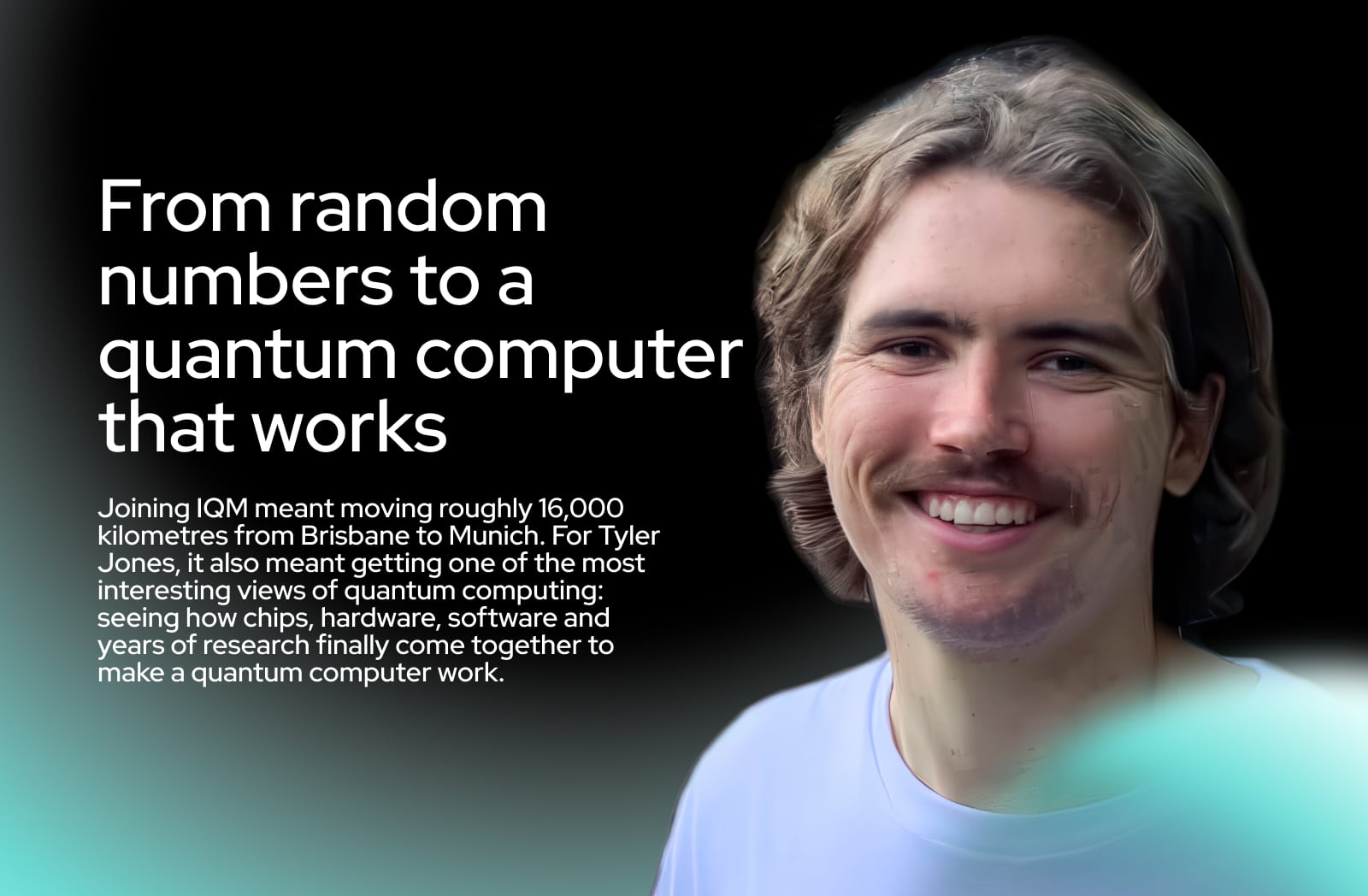
One year became a PhD, with a brief detour into machine learning along the way. Eventually, quantum took me from Brisbane to Munich, where I now work in IQM’s Quantum Integration team.
And the difficult problems definitely haven’t disappeared.
There are people at IQM who understand individual parts of a quantum computer far more deeply than I do.
Our job is slightly different.
In Quantum Integration, we trade some of that depth for breadth. We need to understand enough about the whole system to figure out where to look when something behaves strangely. In the end, we’re responsible for making sure the systems our customers interact with work as they should, whether they’re on-premises or in the cloud.
A customer might run a job and notice that the result doesn’t look right.
Now the fun starts.
Is it the hardware? Calibration? A broken instrument? Software?
Sometimes you find the answer quickly. Sometimes it turns into an investigation lasting weeks.
That means my days can jump between Python, experiments, calibration and customer questions. It also means talking to people across IQM constantly.
“Have you seen this before?” is a pretty normal question around here.
A lot has already happened by the time a quantum computer reaches us.
People have researched the technology, designed the chip, developed the software, built the components and assembled the system.
Then we have to make sure it actually works.
When IQM sells a system, our team helps make sure the specifications are met and that we can say: yes, this is doing what it’s supposed to do.
I really like that part.
You start with a device spitting out random numbers, and slowly tune the individual parts that work together. Eventually, you have a quantum computer giving you the results you expect.
We’re also at the end of a lot of people’s hard work. One of the nice things about that is getting to see the customer happy when they see the shiny machine and, more importantly, when they see the results come out.
One of the reasons I originally wanted to work at IQM was simple: we do everything.
During my PhD, an experimental setup could contain equipment from many different suppliers. Each company wants its own part to work, but making all the individual parts work together for your specific experiment is largely your problem.
At IQM, the people behind those different parts are your colleagues.
If something isn’t behaving as expected, I can talk to someone who researched it, designed it, built it or wrote the software behind it.
We depend on that knowledge.
And it works both ways. We’re close to the systems customers are actually using, so what we learn from them can make its way back to the teams building the technology.
You get a lot of independence, but you’re never really solving these problems alone.
When you work with multiple quantum computers, you quickly learn that they’re not all the same.
Each system needs a bit of specific love. You get to know what’s normal, what isn’t, and what you need to be careful with during calibration.
These differences can be peculiarities of the chip, subtle hardware variations, or even air-conditioning cycles in the rooms which host the systems.
We also sell quantum computers of various qubit counts and architectures, which each come with their own personalities.
But having many quantum computers in the field means we can also start looking across systems.
Is this unique to this one? Have we seen it somewhere else? Is there a pattern? What worked particularly well here that we can repeat?
That perspective is difficult to get from working with a single experimental setup.
You get to learn how real quantum computers behave, while still being surrounded by the people doing the research behind them.
If you want to understand how all the pieces of a quantum computer actually come together, I think this is a pretty unique place to do it.
Molecular simulation is one area I find exciting, especially when you think about potential applications in areas like medicine.
But my part of the problem comes before that.
First, we need to make these incredibly complicated systems work.
Just orchestrating all the pieces of a quantum computer and getting them to behave together is a huge technical challenge.
And if we eventually reach fault-tolerant quantum computing, I suspect some of the most interesting applications won’t be the ones we’re predicting today anyway.
So I’m quite happy leaving that problem to someone else.
I’ll focus on getting the quantum computer to work.
Considering I got into physics to do hard things, I think I ended up in the right place.
Joining IQM also meant moving roughly 16,000 kilometres.
I moved from Brisbane to Munich, which is a fairly big change in scenery. You basically arrive with a bag and start again.
IQM helped with the practical side of relocating, and having a close team made settling in much easier.

Munich also introduced me to something I definitely didn’t grow up doing in Australia: snowboarding.
I’d never tried it before moving here. Now it’s one of my favourite things to do.
I still play Australian football too, there is (surprisingly) a “German league”, and my fiancée and I travel whenever we can.
Moving across the world for a job working on quantum computers wasn’t necessarily where I thought physics would take me.
But so far, it has turned out pretty well.