
There’s a famous quote that “Any sufficiently advanced technology is indistinguishable from magic”
That always resonated with me. If you showed a mobile phone to someone from the Middle Ages, they might think it was magic. But behind that magic is science and the possibility of turning what we understand into technology people can actually use.
That idea has followed me throughout my career.
My mum is a physicist and my dad a chemist, so I grew up in a family of scientists. I was always curious about how things worked, but I also knew I wanted to apply science to real-world problems.
My background is in computational physics. During my postdoc, I moved into quantum computing, later into quantum software, and eventually closer to industrial applications.
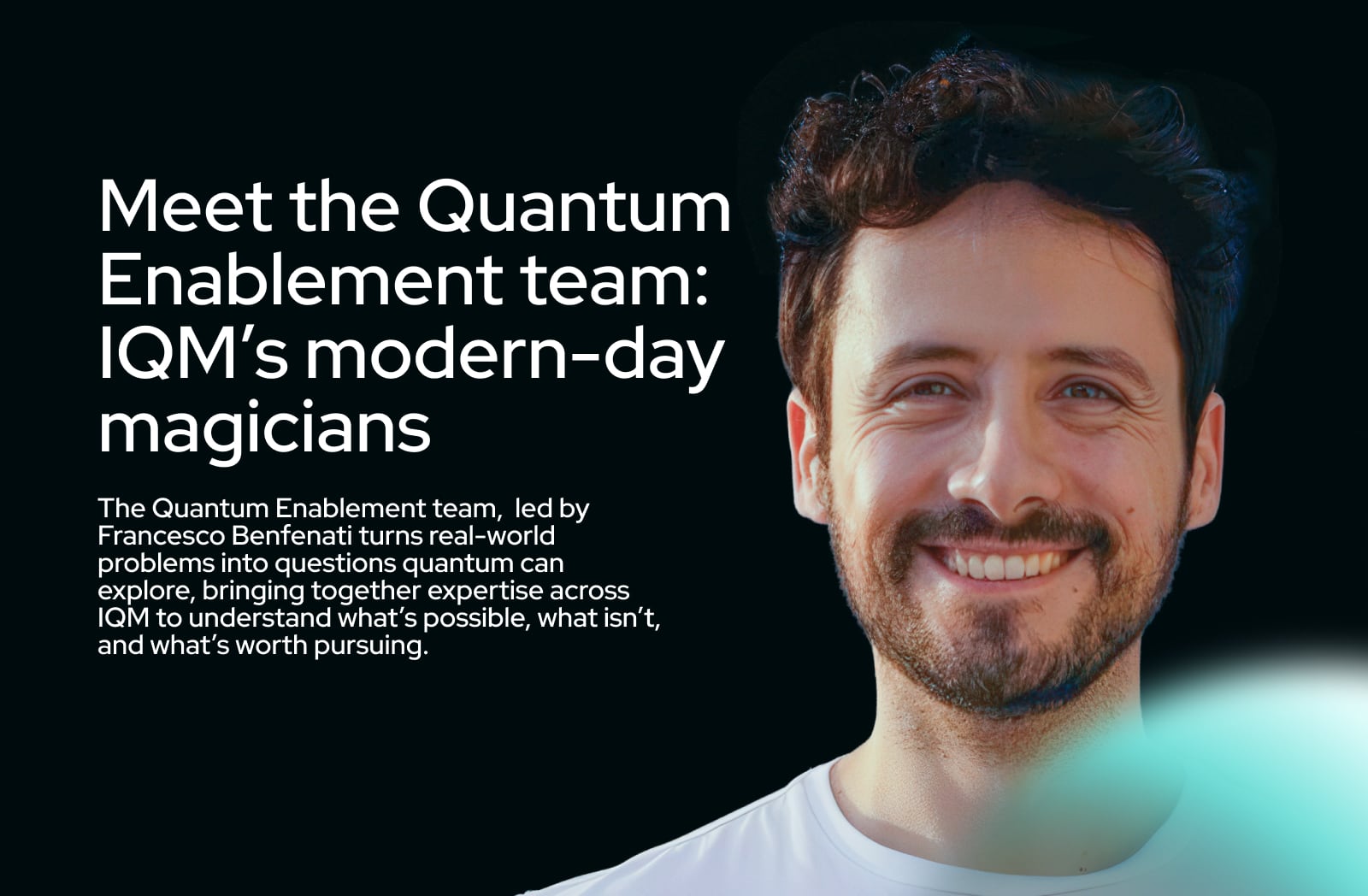
Today, I lead the Quantum Enablement team at IQM.
And if I had to describe the kind of people we are, I’d probably say:
We’re modern-day magicians.
Quantum Enablement exists to answer a simple question:
How do we turn the capabilities of our quantum computers into something that can solve real-world problems?
Without our team, there would be a gap between the technology we’re building and the industrial problems customers want to explore with it.
We enable customers to capture value from quantum computing, hence the team name.
Our team brings together people with different scientific and technical backgrounds, each contributing a different area of expertise.
No one needs to know everything. What matters is knowing how to bring the right people around the problem.
That might take us into quantum simulation, chemistry, optimisation, machine learning and beyond.
That’s one of the things I find exciting about working at IQM. We’re building quantum computers while researching what they can become capable of. We have access to the technology, infrastructure and expertise across hardware, software, algorithms and research all under one roof. While at the same time, customers bring us real problems to explore.
Quantum Enablement sits right in the middle. We’re close enough to the research to go deep, but close enough to the customer to understand why we’re going deep in the first place.
There isn’t really a typical week.
One day, I might be in a technical pre-sales conversation trying to understand a customer’s challenge. Next, we’re deep in the technical work: formulating the problem computationally, working on algorithms, or exploring what the research tells us.
And when we need additional expertise, we can bring in specialists from across IQM.
We’re also often among the first people using new capabilities on IQM’s platform.
I like that the work can move from a customer conversation to an algorithm, a new platform capability, or even back into research.
Customers come to us with their problems.
They can come from completely different industries and technical domains, and our job is to work out what sits underneath.
Can we translate it into a mathematical problem? Is there a quantum algorithm that could be relevant? Is the technology mature enough to investigate it? Does an existing approach work, or do we need to explore something new?
Or is quantum simply not the right answer?
That last question is important.
There’s a lot of excitement around quantum computing, and understandably so, but our job isn’t to put the word quantum in front of every customer challenge.
We need to understand what the technology can do, what it can’t do yet, and where there is something genuinely worth exploring.
Quantum chemistry and materials science are particularly fascinating to me because the systems we’re trying to understand are themselves quantum mechanical.
Could quantum computing eventually contribute to more energy-efficient ways of producing fertiliser? What could better materials simulation unlock?
Then there are questions in optimisation, logistics and machine learning, including potential applications in areas such as oncology.
I’m deliberately saying could.
We’re trying to find the places where quantum can genuinely make a difference.
That’s also why I moved from academia towards industry.
I love research, but I became increasingly interested in one question:
What happens after the paper?
I wanted to see what happens when research meets a real-world problem, when an idea gets tested, adapted and potentially turned into something useful.
At IQM, that journey isn’t one-way. Research can lead to an industrial application, and a customer challenge can raise a completely new research question.
I like being somewhere in between.
We can’t do this work in isolation.
A customer brings deep knowledge of their industry. We bring expertise in applications and algorithms. And within IQM, we bring in researchers, algorithm experts, software engineers, quantum error correction experts or other specialists depending on what the problem needs.
That means being comfortable not knowing the answer yet.
The next conversation might bring us an industry we’ve never worked with, a problem we’ve never seen, or a question the existing research doesn’t answer.
Can you get curious rather than uncomfortable? Can you explain complexity clearly?
And can you admit when quantum isn’t the right solution?
Technical depth matters. But so does being able to say:
I don’t know. Let me figure it out.
Quantum computing can look like magic from the outside.
And maybe we are modern-day magicians, not because we have all the answers but because we get to work on questions where the answers aren’t always obvious or don’t exist yet.
Maybe that’s where the real magic happens.

That desire to figure things out has followed me well beyond science. I play piano and guitar, surf, ski in the Pyrenees, and when I have enough time, cook recipes that are probably more complicated than they need to be.
Soon, I’ll also become a parent.
So I suspect there’s still quite a lot left for me to learn.