
Until recently, the most prevalent version of the quantum story was all about raw capability. More qubits, better fidelity, the next lab record. While that work matters and is very important, it is not the thing standing between where we are and quantum computers doing real work inside real organisations.
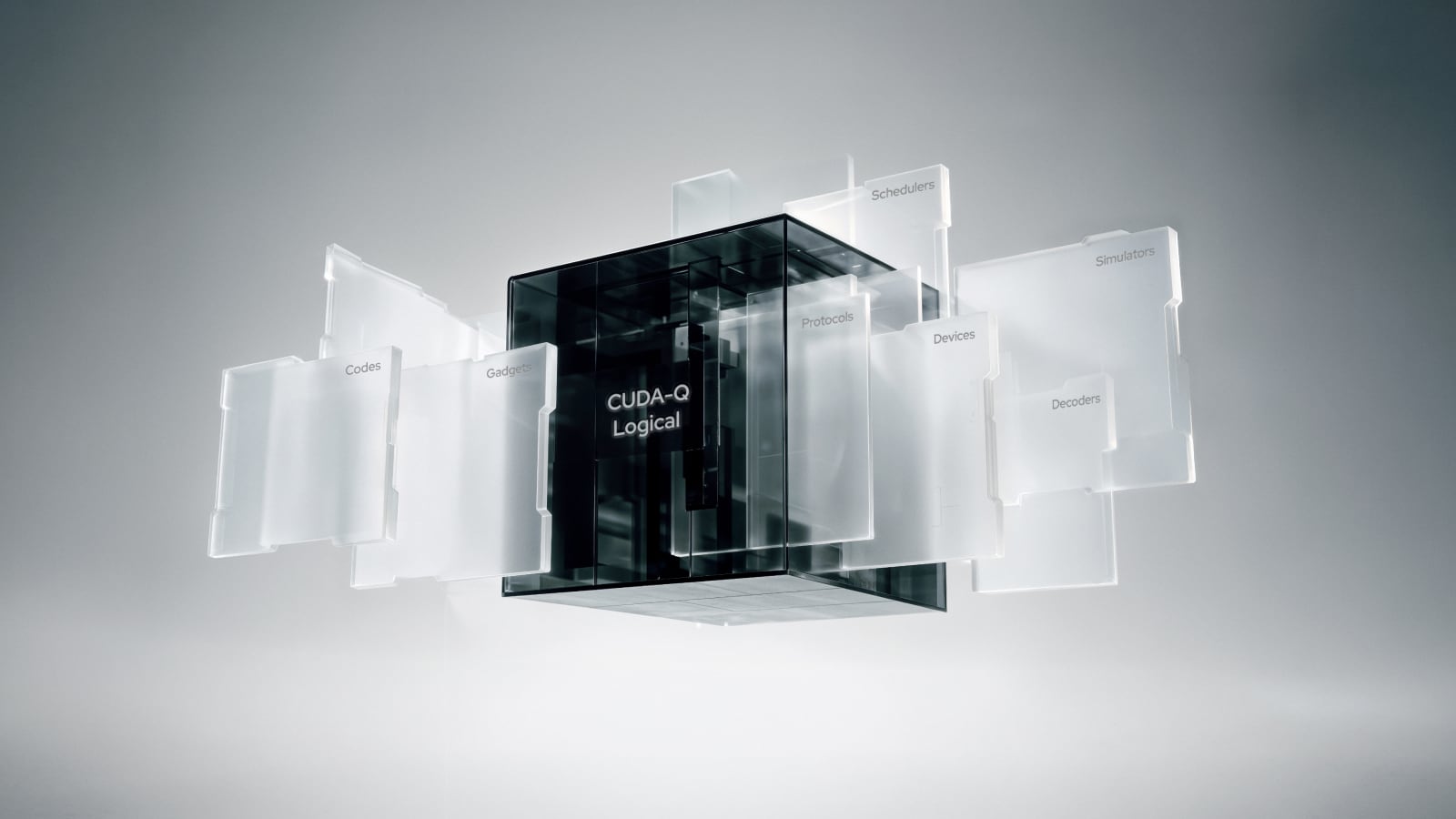
What stands in the way is that fault-tolerant quantum computing has been a black box. Not a metaphorical one. Until now, running a serious error-correction experiment did not mean writing a program and pressing go. It meant working down the stack until you were tweaking the low-level of the machine, down to the FPGAs controlling the QPU. The code, the decoder, the timing model, the control logic, all of it sat in one vendor-specific bundle. Getting at any of it meant getting at all of it.
That is also why so little of this work is comparable. Two groups can run the same nominal experiment on two machines and produce numbers nobody can line up, because the two stacks differ all the way down and neither is open to inspection.
NVIDIA CUDA-Q Logical, announced this week at IEEE Quantum Week, opens the box. We are glad to be an early adopter of it.
CUDA-Q Logical expands CUDA-Q with an open, extensible logical layer for expressing fault-tolerant workloads. You express a workload once and then evaluate it across different QEC codes and system architectures without rewriting it. The same program can be fairly compared across radically different fault-tolerant architectures, from high-rate qLDPC codes to surface codes, without changing the workload or the metrics involved.
Around that layer sit clear and segmented extension points: codes, gadgets, protocols, devices, schedulers, simulators, and decoders. A team can plug in its own and have the result compose into one auditable, reproducible experiment. Resource estimates at various levels of detail can be made on the same compilation, so you can see not only qubit counts but where the time actually goes, in decoding, in transport across the architecture, in control bandwidth. And because the extension points are clean, a vendor can bring a proprietary architecture into a state-of-the-art resource estimate without revealing sensitive information.
Taken together, that is a workbench for fault-tolerant quantum computing. Open, extensible, and comparable across vendors and modalities. It turns a slow, ad hoc research exercise into something closer to engineering, which is exactly the kind of barrier that has to come down for quantum to be usable by more than a handful of specialists.
Open design tools still have to run on real machines. A layer that lets you compare architectures is only worth as much as your ability to then build the hardware, deploy it, own it, and operate it.
That is the part we build. IQM Halocene is our product line for [std marketing content here]. Halocene is where a design that looks good in a resource estimate goes to meet a real QPU.
It is also where the accelerated part comes in. Real-time error correction is a co-design problem that reaches across the QPU, the control electronics and the GPUs together. Halocene supports a full accelerated quantum compute workflow end to end, integrated with the open tooling the field is standardising on, including NVIDIA NVQLink for tightly coupling QPUs with GPU supercomputers and the CUDA-Q open source quantum development platform. With CUDA-Q Logical, that stack now has an extendable, open-source fault-tolerant layer sitting on top of it.
Getting to fault tolerance was never going to be one company’s breakthrough. It is a co-design problem that runs across applications, error-correcting codes, logical architectures, physical hardware, decoding and control, and you do not solve it in a closed room. What changes with an open logical layer is that the field can design in the open and compare approaches honestly, instead of each group tuning its own black box and hoping the numbers mean the same thing.
Our job is to make sure that when those designs are ready, there is real hardware to run them on. Machines an institution can own, operate and build on, without rebuilding the entire toolchain themselves. That is what turns a research result into something a customer can actually use.
The black box is open. There is plenty more to do

Max Haeberlein leads software ecosystem partnerships at IQM Quantum Computers. He owns the technical relationships that connect IQM’s hardware to the wider HPC and AI software stack. Before IQM he spent seven years at Intel, building AI applications for chip design and leading the team behind them. He started at the Walther-Meissner-Institute, working on some of Germany’s early superconducting quantum processors. Max works where quantum hardware, software, and commercial strategy meet.
Search faster—hit Enter instead of clicking.
Click to expand