
AMD and IQM are demonstrating how quantum computing and GPU-accelerated HPC can work together in a unified scientific workflow. Using an IQM quantum computer and an AMD GPU powered by ROCm, the collaboration divides a chemistry problem across quantum and classical compute, with each architecture handling the work it is best suited to perform. The quantum computer narrows an exponentially large search down to the electron configurations worth examining, and the GPU solves the problem that remains. The molecule is small, but the workflow is real, runs on real hardware, and anyone can reproduce it.
This is the first in a series of posts on joint work between AMD and IQM to connect quantum computers with high-performance computing. It demonstrates a practical way to divide a computational problem between the two today, and where the integration needs to improve.
The workflow calculates a molecule’s ground state and ground-state energy: the configuration and lowest possible energy of its electrons. Most of a molecule’s chemical behavior follows from its ground-state energy, which makes it relevant for drug discovery, materials design and similar fields.
The exact answer, within a chosen set of orbitals, comes from a matrix with one row for every way the electrons can be arranged. The number of arrangements grows exponentially as electrons and orbitals are added. Beyond small molecules, the matrix becomes too large to store or solve, even on the largest classical systems.
The method is called Quantum-Selected Configuration Interaction (QSCI). The idea is simple: most of the huge matrix does not contribute to the result. Only a small number of electron arrangements contribute meaningfully to the answer. The challenge is finding them.
The quantum computer’s job is to find those configurations. Each qubit stands for one orbital an electron can occupy. We train a circuit so that the state it prepares approximates the molecule’s ground state. Each measurement then returns one electron configuration, and the important ones come up most often.
The circuit does not have to be perfect. It only has to point to the right configurations. The AMD GPU takes it from there. It filters out unphysical samples, builds the Hamiltonian matrix over the remaining configurations, and diagonalizes it using JAX on AMD ROCm. This gives the energy and the exact weight of each configuration within that set.
In short: the quantum computer chooses where to look, and the GPU solves the problem there.
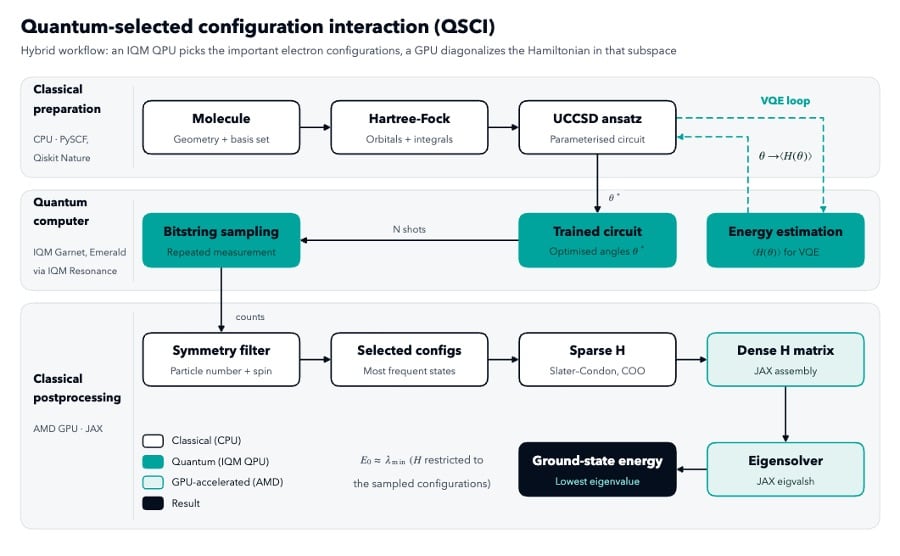
[Figure 1: Workflow diagram showing how the work is split between the IQM quantum computer and the AMD GPU]
We ran the full QSCI pipeline on hydrogen (H₂, STO-3G basis). We started with a simulator, then ran it on the IQM Garnet quantum computer through IQM Resonance, IQM’s cloud platform. We checked both runs against an exact classical solution.
H₂ is deliberately small. This run does not show quantum advantage, and it is not meant to. It demonstrates that the pipeline works end to end, using a real quantum computer and an AMD GPU, each doing its own part of one workflow.
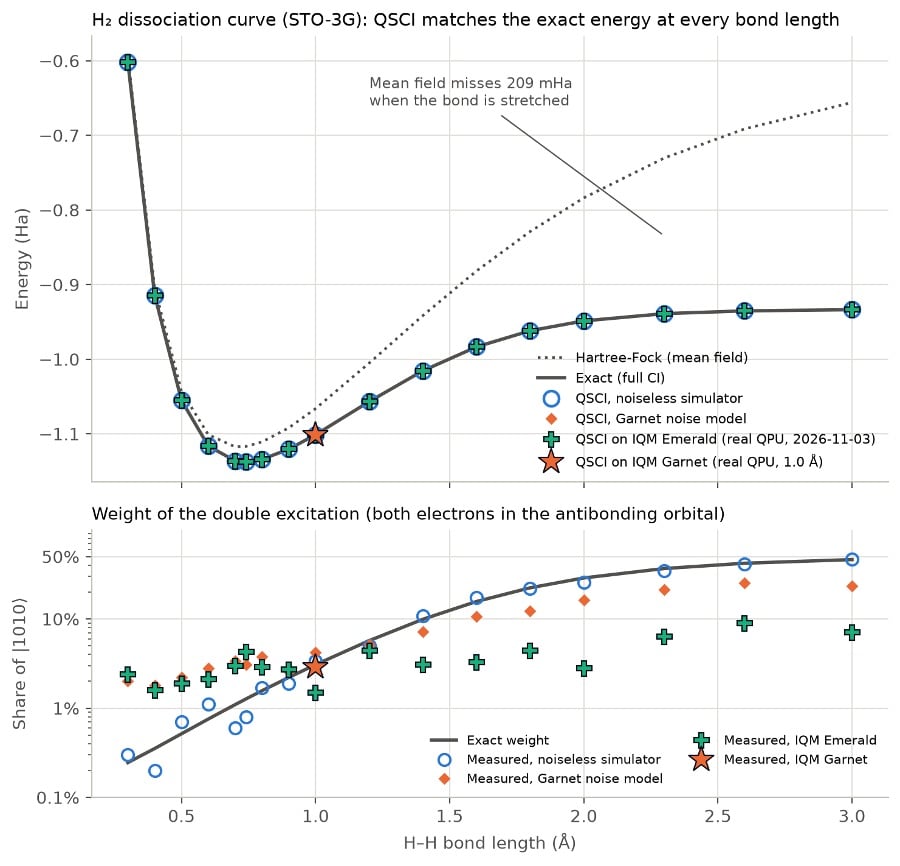
[Figure 2: Dissociation curve of H₂, with all 17 bond lengths measured on real IQM hardware]
A lot of published work simulates quantum computers on GPUs. This is different. Here the quantum computer and the GPU each contribute to the scientific workflow, on real systems, today.
This is an important direction for hybrid classical-quantum high-performance computing. Supercomputing centers are looking for applications where the two can be combined, and there is still open debate on how best to connect QPUs and GPUs. QSCI and its extensions are promising candidates for real impact once the next generation of quantum systems is ready to work closely with GPUs, and this work shows the two can already be connected for this purpose. While this is not the final architecture, this workflow is a practical approach that runs today.
The classical computation remains demanding. Sampling keeps the problem tractable, but the cost of diagonalization grows with the cube of the subspace size. As molecules get larger, the classical work gets expensive quickly. This is where AMD GPU acceleration matters. That classical workload is central to scaling hybrid quantum applications. AMD Instinct GPUs and ROCm provide an open, high-performance foundation for accelerating the classical computation surrounding the QPU, creating a path to integrate quantum workloads into the HPC infrastructure researchers already use.
The integration also required engineering. Software versions had to be pinned carefully, and ROCm needed a couple of fixes along the way. Addressing these is part of the point: building a software path between IQM quantum computers and AMD infrastructure that others can use.
The workflow is open and reproducible. You can run this workflow today at IQM Academy, where the full tutorial is available as a Jupyter notebook. You need an IQM Resonance account and access to the AMD Developer Cloud, or your own AMD GPUs. AMD offers developer credits on request.
Launch a GPU droplet on the AMD Developer Cloud, follow the setup guide in the notebook, and run it. GPU acceleration switches on automatically on a droplet.
You can also start without GPU or quantum credits. The simulator path works out of the box, so you can explore the workflow before moving to hardware.
Work is already underway on two next steps.
The first is tighter integration. Today the quantum computer and the GPU work through the cloud. AMD and IQM teams are working on connecting GPU nodes and quantum processors more directly. The next question is which applications to prioritize. Error correction is one candidate, and many are working on it. Applications like this chemistry workflow are another.
The second is scale. We will run larger molecules and find where QSCI hits its limits, on both the quantum and the classical side. The method is expected to start paying off at around eight qubits and above. Better circuits, more shots, and measuring how the GPU speedup grows with problem size are all part of this work.
For organizations already running AMD GPUs, this points to a practical path: adding quantum to existing HPC infrastructure, with applications that use both. AMD and IQM will continue advancing this model across larger scientific workloads while exploring tighter integration between quantum processors and AMD accelerated computing. The goal is to help define an open, scalable architecture where quantum, HPC and AI can operate together as parts of one scientific computing environment.
We will share results as they come.