
An interview with Jan Goetz, CEO of IQM Quantum Computers, and Toshiya Kohno, CEO of TOYO Corporation
When TOYO Corporation announced the purchase of Japan’s first IQM quantum computer, the news started a shift in how one of the world’s leading industrial economies is approaching quantum computing: from observation to ownership.
In this joint conversation, IQM CEO Jan Goetz and Toshiya Kohno, Representative Director, President and CEO, TOYO Corporation, discuss why this moment matters, why quantum infrastructure needs more than cloud access alone, and why Japan is emerging as one of the most strategically important quantum markets in the world.
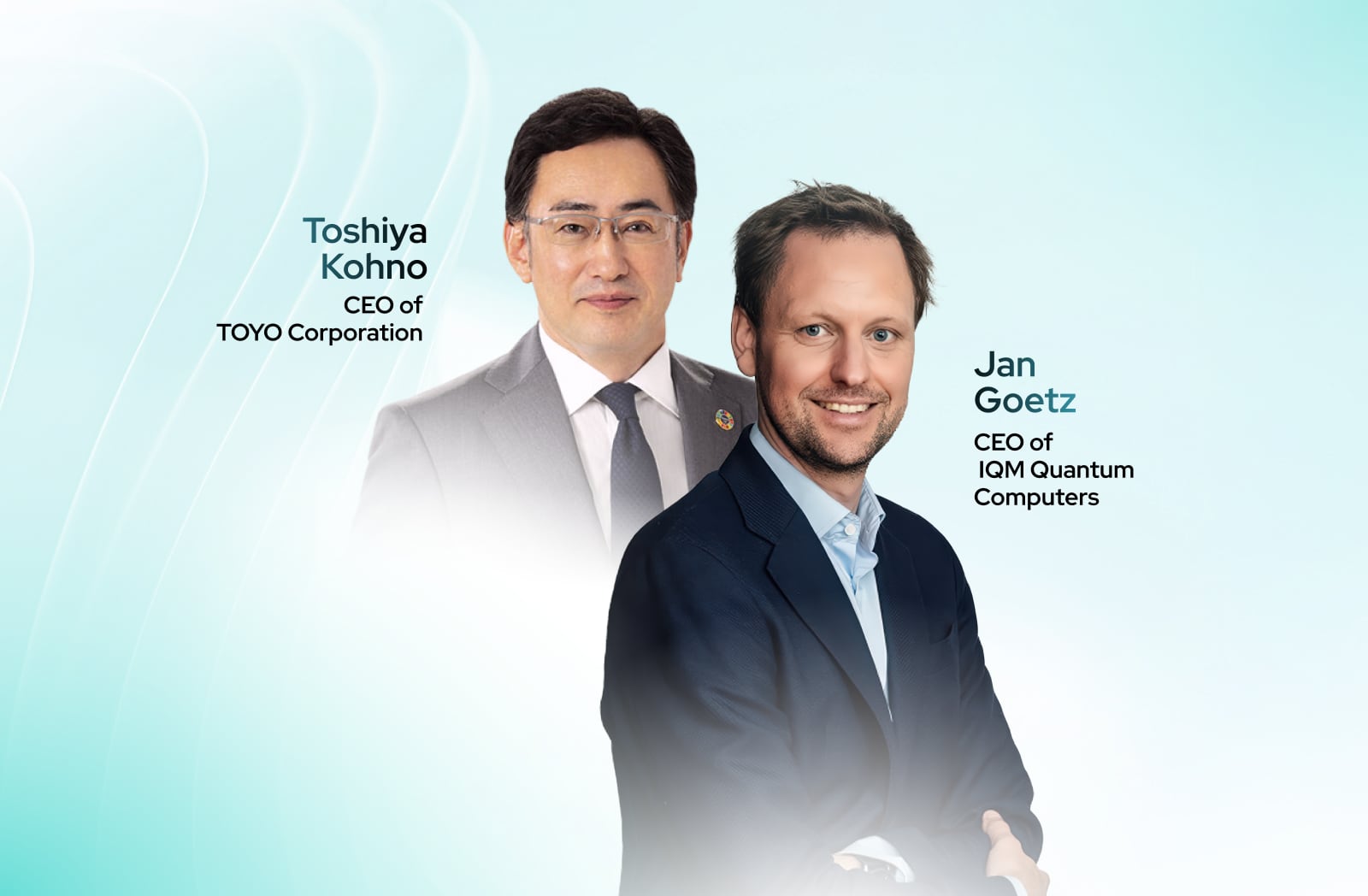
Toshiya Kohno, CEO, TOYO Corporation
This partnership reflects the strong alignment between IQM’s world-leading quantum computing technology and TOYO’s core strengths in measurement, analysis, and evaluation.
Quantum technology is positioned as a key growth area for us, and this collaboration marks an important step as we move into a new domain and help accelerate the implementation of quantum technologies in Japan.
Jan Goetz, CEO, IQM Quantum Computers
TOYO is IQM’s first Japanese customer, and the fact that the buyer is an advanced tech company is exactly the right signal. They understand instrumentation and complex systems. They know what advantages direct access to hardware gives you. Capability is built by people who can touch the machine, who can grow with their infrastructure. TOYO joins LRZ in Germany, ORNL in the United States, Galaxy in Poland, and many more. All institutions that decided to own their quantum future.
Kohno
Japan has global competitiveness in materials science and advanced manufacturing fields, where quantum computing can have a significant impact.
National-level R&D is progressing, and the technological foundation is steadily taking shape. At the same time, corporate education and practical adoption are still developing, meaning the market is just beginning to take shape.
This combination makes Japan a highly promising and strategically important market for quantum computing.
Kohno
The environment around quantum computing has shifted dramatically in recent years.
Beyond technological progress, companies are now exploring concrete use cases, moving from research to implementation planning.
Since we began offering quantum solutions, we have seen growing demand for real-machine testing, HPC integration, algorithm development, and talent training. These emerging practical needs indicate that now is the right time to invest in quantum infrastructure.
Goetz
The question used to be whether quantum matters. That question is answered. The question now is how organizations build the capability to use it. And what it costs them if they hesitate. Every on-premises customer we have, in every country, wants the same thing: a real machine they can run real workloads on, in their own facility, integrated into their own infrastructure. That is what hardware ownership provides.
Kohno
Cloud access alone is no longer sufficient to meet customers’ needs for hands-on testing and skill development.
Many organizations require real-machine evaluation, HPC integration, and practical training environments.
To support these needs and advance the implementation of quantum technologies in Japan, we decided to own and operate quantum systems ourselves.
Goetz
Cloud is a starting point to get comfortable with quantum computing. It lets you try the technology; it does not let you build with it. Advanced users choose ownership for a specific reason: sovereignty is not a slogan, it is a procurement requirement. Hardware in your facility, workloads on your own infrastructure, IP that stays inside your walls, expertise that compounds inside your team. That is what we call Production Quantum. It is what TOYO has chosen.
Kohno
Quantum computing has a significant gap between theory and real-world hardware behavior.
Direct access allows users to understand system characteristics and constraints, enabling more realistic evaluation and decision-making.
Hands-on experience is essential for moving toward practical adoption. It also allows customers to maintain confidentiality for sensitive data that cannot be sent to the cloud.
Kohno
This is a strategic partnership aimed at enabling the adoption of quantum technology in Japan, not a simple vendor arrangement.
Together, we will co-create value through use case development, talent training, and deeper engagement with industry needs.
By combining TOYO’s expertise in measurement and advanced technologies with IQM’s quantum systems, we aim to bring practical quantum applications to life.
Goetz
Vendors do not build quantum ecosystems. Corporations, universities, governments, and HPC organizations build them together. IQM’s job is to provide the ecosystem platform and earn the trust to keep providing it. TOYO brings something we cannot bring on our own: relationships across Japanese industry built over decades. That is the difference between selling a machine and helping a country build a capability. We are interested in the second.
Kohno
Talent is one of the most critical factors for the practical adoption of quantum computing.
Even when fault-tolerant quantum computers become available, organizations will only benefit if they have people capable of using them effectively.
Infrastructure alone is not enough. Human capability must grow alongside it.
By bringing IQM systems to Japan, we aim to provide hands-on educational and research environments that foster practical, future-ready quantum talent.
Kohno
Success means seeing quantum technologies steadily implemented across Japan, with more real-world industrial and business applications emerging.
It also means cultivating quantum talent and continuously generating new use cases.
Both IQM and TOYO share the ambition to bring quantum computing into industry as early as possible and drive innovation. We aim to advance this vision together.
Goetz
Success is Japan becoming one of the places where quantum computing gets commercialized, not just studied. Japanese institutions running real workloads, integrating quantum into HPC, training engineers who will lead this field for the next twenty years. That is not a five-year program. It is a generational one. TOYO is the start.
Kohno
Quantum technology is a strategic field that will underpin future economic growth and is essential for shaping the next generation of Japanese manufacturing.
By introducing an IQM quantum computer, we hope to expand opportunities for industry, government, and academia to engage directly with quantum hardware.
Competition around HPC integration, use-case development, and talent training has already begun.
Working with IQM, we aim to accelerate industrial adoption and societal implementation, helping Japan become a global leader in quantum technology.
Goetz
Ecosystems compound. Once a country has real infrastructure, the rest follows: researchers find industrial partners, universities train specialists, companies identify use cases, governments invest at scale. None of it happens without the hardware in place first. The quantum era does not arrive when the machine works. It arrives when institutions own it, operate it, and build with it. Japan now has both the hardware and the institution that intends to do all three. The work begins today.

Emilia Stuart is a content strategist and storyteller at IQM Quantum Computers, specializing in translating complex quantum computing concepts into engaging narratives. With a background in research and tech marketing, she understands potential customers and crafts stories that resonate. Emilia’s passion is making intricate technologies accessible to diverse audiences.
Search faster—hit Enter instead of clicking.
Click to expand