
Quantum computers are often pitched as future problem-solvers for hard optimization problems that show up everywhere: scheduling, network design, logistics. The catch is that today’s machines are small and noisy, and the leading quantum optimization method, the Quantum Approximate Optimization Algorithm (QAOA), usually gives good-but-not-great answers on real hardware. The natural instinct is to push the quantum machine harder and run deeper circuits. But that’s exactly what current devices are worst at.
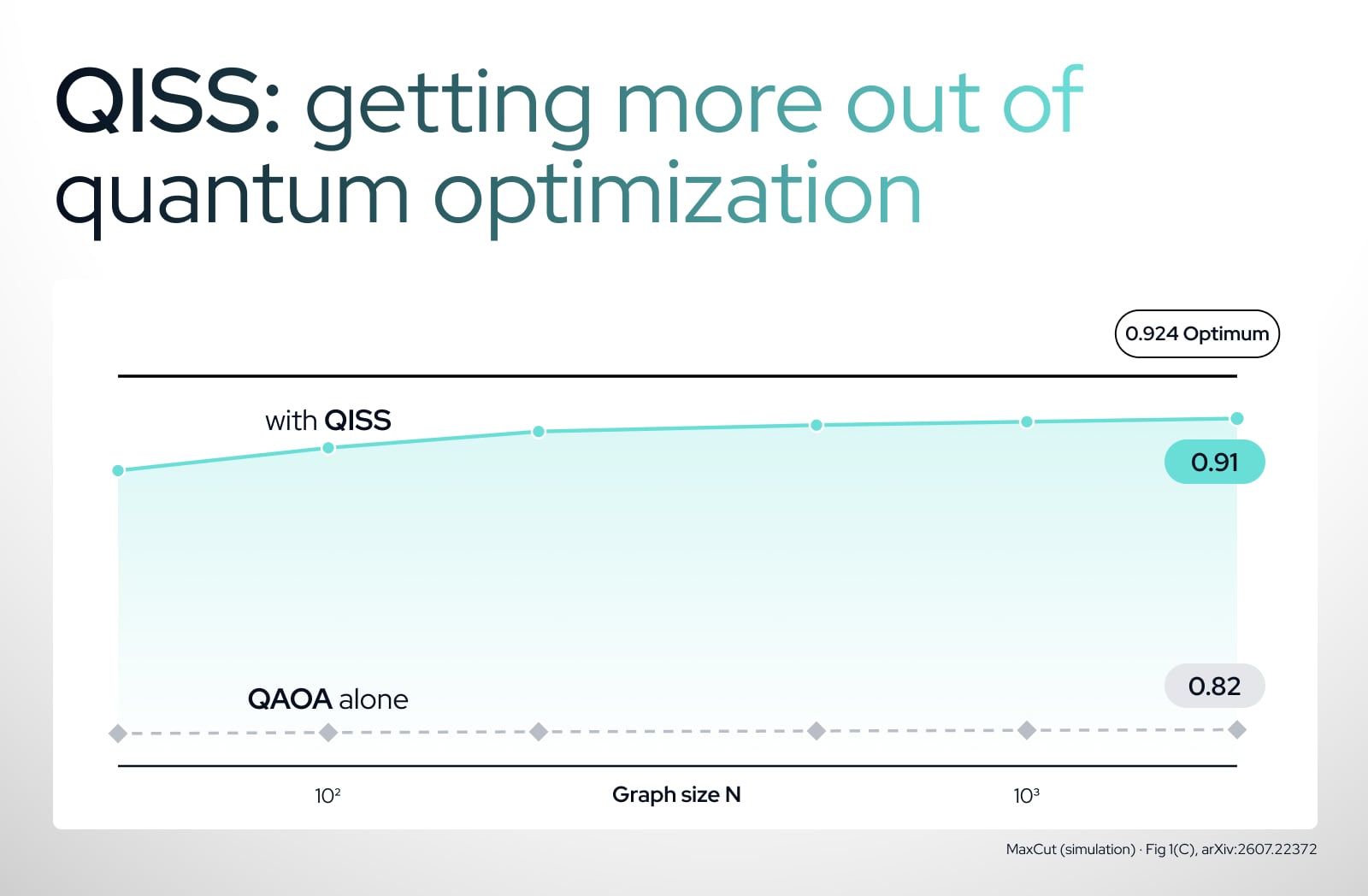
In http://arxiv.org/abs/2607.22372 we took a different route. Instead of asking more of the quantum computer, we asked more of the outcomes it had already produced, and did the extra work on a classical laptop. It’s an illustration of what Production Quantum looks like day to day: not waiting for bigger, cleaner hardware, but getting more useful answers out of the machines already running.
When QAOA runs, it doesn’t just produce a single answer. Along the way it produces a set of statistical fingerprints: averages describing how pairs of variables in the problem tend to align. These are cheap to measure and tolerate some amount of noise. The usual approach reads off a set of candidate solutions and stops there, leaving that statistical information on the table.
QISS (quantum-informed surrogate sampling) treats those fingerprints as a starting point rather than an endpoint. We use them to build a classical model, a kind of structured map, then explore that map with a well-established classical technique, Markov chain Monte Carlo sampling, to construct better candidate solutions than QAOA reported on its own.
Building the model requires no extra training and no additional tuning. The map is written directly from the measured quantum expectation values. There’s nothing to optimize and no new knobs to turn.
Three things make this worth doing.
First, it is essentially free. The quantum measurements have already been taken, the classical post-processing is cheap and runs on ordinary hardware.
Second, it is noise tolerant. Because the model depends on the measurements only through a smooth function, small measurement errors change the results gently rather than breaking them. We tested this on a 54-qubit quantum processor and recovered performance close to the noiseless ideal.
Third, it is not just relevant for today’s noisy machines. Even future, error-corrected quantum computers will face steep costs: recent estimates for a related algorithm suggest that beating the best classical solvers could require on the order of a million physical qubits. Squeezing more out of each quantum measurement classically eases those demands too. Better post-processing lowers the bar the quantum hardware has to clear, now and later.
We tested QISS on two hard optimization problems, MaxCut and Maximum Independent Set, across a wide range of sizes. It reliably improved on the raw QAOA output, reaching solution quality on par with established classical heuristics. We also ran it on the IQM Emerald 54-qubit quantum processor, where it held up well against hardware noise.
Taken together, these results show that cheap classical post-processing can reliably turn a quantum optimizer’s raw output into better solutions, on today’s noisy devices and on the error-corrected machines to come.
Building quantum technology is only half the job. The other half is knowing what to do with the answers they give you, and that’s where a full-stack company has an advantage: the same team that operates the processor can also build and test the classical layer around it. QISS is a concrete example of that advantage in practice. It was developed and verified on our own 54-qubit processor, Emerald, not as a hypothetical benchmark but as a working part of the stack.
Contact Elisabeth Wybo, Team Lead Optimization, for more information.

Elisabeth Wybo holds a PhD in quantum many-body physics from the Technical University of Munich. She joined IQM in October 2022 and have been serving as Team Leader, Optimisation since October 2024.
Search faster—hit Enter instead of clicking.
Click to expand