
I spent much of my scientific career studying open quantum systems, and in particular non-Markovian dynamics. At its heart, this field asks a deceptively simple question: where does a quantum system end and its environment begin?
The systems that fascinated me were those where that boundary is not clean. The environment can become correlated with the system and feed information back into it, so deciding which degrees of freedom belong to the system—and how to represent the influence of everything else—becomes part of the physics.
Quantum computing starts from an almost opposite engineering ambition. Its ideal gates are unitary, reversible transformations, and high-fidelity hardware must protect those intended dynamics from uncontrolled interactions.
Yet the moment we use a quantum processor to simulate chemistry or materials, the system-environment question returns. A catalyst may sit inside a protein or on a surface; a molecule may be surrounded by solvent; a material contains vibrations, defects and interfaces.
So before asking how many qubits we need, there is an earlier question:
I have been hearing Feynman’s famous observation—“Nature isn’t classical, dammit, and if you want to make a simulation of nature, you’d better make it quantum mechanical…”—for almost as long as I have been working in quantum science.
For a long time, I did not interrogate it very much. Nature is quantum; quantum systems can be hard to simulate classically; therefore quantum computers should be natural machines to simulate them. It was only when I started leading teams trying to turn that intuition into something scientifically useful—and ultimately into industrial value—that I began to ask what it means in practice.
Because nature being quantum does not mean putting a raw microscopic description of nature directly onto a quantum computer.
Computational chemistry and materials science have spent decades learning how to formulate useful effective problems instead: which degrees of freedom must remain explicit, which can be integrated out or approximated, how environmental effects should enter, and which symmetries or physical principles can be exploited. Crucially, this separation between the explicitly treated system and the degrees of freedom represented effectively need not remain fixed: as a reaction proceeds, a molecule changes conformation, or its environment evolves, the degrees of freedom that require explicit treatment may change as well.
The objective is therefore not to preserve every microscopic detail at all times, but to preserve the physics needed for the quantity we want to predict while keeping the model tractable across the relevant configurations, environments and stages of the process.
Accuracy and predictivity are not synonymous. A useful effective model must therefore do two things at once: retain the quantum physics that requires the most accurate treatment, and remain representative—and computationally accessible—across the environments, configurations and operating conditions from which the observable emerges.
Even after we have formulated a meaningful effective model, not every part of it is equally difficult. Nor is there a simple measure—such as the amount of entanglement—that tells us when a quantum computer is required. Some highly entangled quantum states can still be simulated efficiently on classical computers; Clifford circuits under the Gottesman-Knill conditions are a familiar example.
In electronic-structure problems, however, we do have qualitative indicators of classical difficulty. One occurs when many electronic configurations lie close in energy and none provides an adequate description on its own. Transition-metal systems are prominent examples: partially occupied d orbitals can produce competing spin, charge and orbital configurations together with strong static, or multireference, and dynamical correlation.
These features make many classical approaches increasingly challenging and are one reason transition-metal catalysts and strongly correlated materials appear frequently among candidate quantum-computing applications.
But they remain indicators of classical difficulty, not certificates of quantum advantage. Classical algorithms can exploit structure in ways that are difficult to anticipate, and the frontier of what is tractable keeps moving.
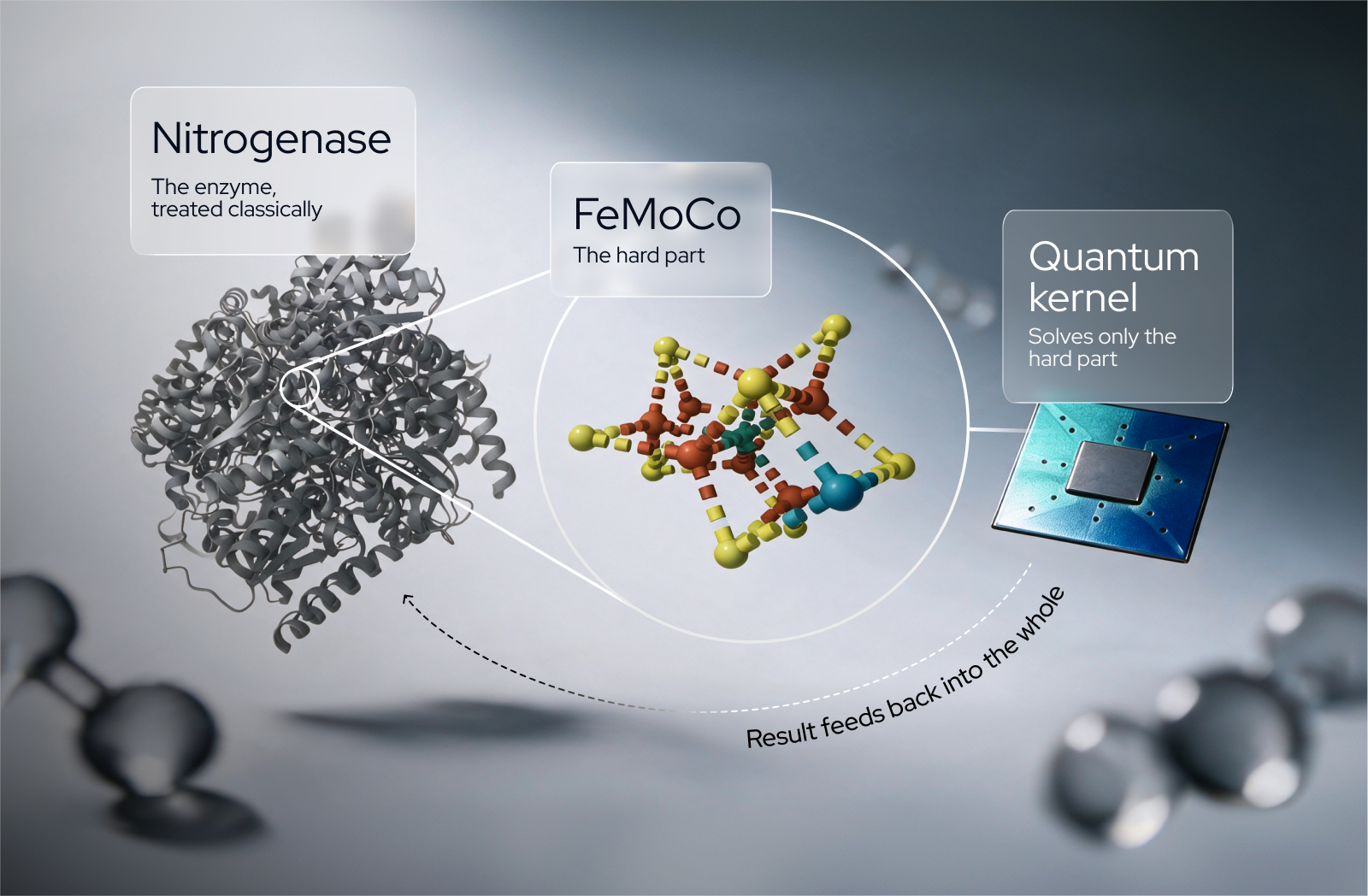
FeMoCo is a particularly telling example of how quickly that frontier can move. As the transition-metal catalytic cofactor at the active site of nitrogenase, it combines precisely the ingredients that make these systems challenging: several metal centres, many unpaired electrons and competing electronic configurations. It is also chemically important, because nitrogenase catalyses the conversion of atmospheric nitrogen into biologically usable forms.
For these reasons, a widely studied 113-electron, 76-orbital model of FeMoCo became one of the canonical targets for fault-tolerant quantum-computing resource estimates.
Earlier this year, however, Huanchen Zhai, Garnet Chan and collaborators calculated its ground-state energy classically to an uncertainty on the scale conventionally called chemical accuracy. That was significant because this particular model had long been treated as an example of a chemically relevant calculation lying beyond practical classical reach.
Much of the advance came not from an entirely new family of algorithms, but from substantial classical compute combined with a much more problem-aware use of established methods. The 76-orbital Hamiltonian is also only an effective model; more complete descriptions involve larger orbital spaces and additional environmental and configurational physics.
However, the lesson is not that classical computing has won or quantum computing has lost, but rather that the frontier moves. Better physical insight can change which parts of a problem are genuinely hard, and where the most expensive computational treatment is actually needed.
This is where hybrid quantum-classical approaches become particularly interesting. After classical algorithms and physical insight have simplified a problem as far as possible, a difficult correlated sector—or a particular computational step—may still dominate the cost or limit the achievable accuracy. That is a natural place for a quantum processor to enter as a computational kernel, rather than replacing the complete workflow.
In quantum embedding, for example, a quantum solver can treat a strongly correlated active region while the surrounding system remains classical. In quantum-classical auxiliary-field quantum Monte Carlo, QC-AFQMC, the quantum processor can provide information from a more sophisticated trial state while the Monte Carlo propagation remains classical.
The principle is simple: use quantum resources where they provide leverage, and retain efficient classical methods everywhere else.
How do we determine when such a kernel is worthwhile?
One strategy is bottom-up. We start from a scientifically well-defined, often idealized problem whose quantum and classical components can be characterized carefully. Through simulation, resource estimation and, where feasible, current quantum hardware, we ask: when does a hybrid quantum-classical approach begin to outperform the best purely classical alternative?
This helps identify when quantum advantage may emerge for such toy models, which can then become progressively richer. At IQM, our algorithm and simulation teams pursue this route in work such as QC-AFQMC, moving from controlled benchmark systems toward models relevant to applications such as battery optimization.
The complementary strategy is top-down—more pragmatic, almost a “shut up and calculate” approach. Here we start from an industry-relevant workflow in which the physical context of the prediction is already part of the problem: the relevant environments, configurations, temperatures, compositions, sampling requirements and observables. We then ask where a quantum kernel can be introduced within that workflow, using simulation, emulation or available quantum hardware as appropriate.
This does not avoid the fundamental question of quantum advantage; it approaches it from the opposite direction. The bottom-up route asks when quantum computation becomes technically advantageous for an increasingly realistic problem. The top-down route starts from the realistic problem and asks where quantum computation can contribute within it.
Industry workflows connect accurate calculations to the configurations and operating conditions in which the system will actually be used. They produce predictions that are key to then make decisions:
Will this molecule bind? Will this electrolyte remain stable? Which catalyst is worth synthesizing? How will a material behave under relevant conditions?
That predictivity is what creates the economic case for simulation. A workflow has value if it makes those answers more reliable, obtains them faster, reduces expensive experiments, explores more candidates or shortens development cycles.
The return on quantum computing will ultimately have to be judged in those terms too.
This is why I am particularly excited about bringing Quantistry’s platform and team into IQM. Useful quantum simulation requires a chain from physical problem to effective model, computation, sampling, validation and finally an industrially meaningful prediction.
That chain is inherently multidisciplinary. Hardware and software engineers understand what the processor can execute. Chemists and materials scientists know which approximations are defensible, what needs to be sampled and which observables actually matter. Together with algorithm researchers, they also explore where higher-accuracy calculations are justified so that quantum kernels may potentially bring value. Business and market experts identify where better predictions translate into meaningful value—which problems matter most, how decisions are made and what improvement would justify changing an existing workflow. An industrial platform connects those competencies across real use cases and datasets.
So the future is classical simulation, AI and quantum-computing kernels, each used where it contributes most. And as quantum computers become more capable, the imperative is not to feed them ever larger problems indiscriminately, but better-formulated ones—and to judge their value not through isolated calculations, but through the predictive workflows in which they belong.
Effective models and hybrid workflows will not disappear with fault tolerance. Nature is “messy” because relevant properties emerge from many interacting degrees of freedom across different scales; transforming that reality into a useful computational problem will remain part of the science.
What may change is how strongly computational scarcity constrains that formulation. Today we restrict active spaces, truncate correlations and separate parts of systems partly because a more complete treatment is prohibitively expensive. Larger fault-tolerant quantum computers may allow us to treat substantially larger correlated sectors directly, helping separate approximations chosen for physical reasons from those imposed simply because we cannot afford anything better. And that could expand more than accuracy: it could expand the space of questions we are able to ask, and allow us to explore broader families of quantum models and regimes.
Feynman was right that nature is quantum. What computational science adds is that the quantum problem has to be constructed before it can be solved. Today that construction is partly shaped by the limits of our tools. As those limits move, we should remain open not only to solving familiar problems better, but to asking new ones.
The question may ultimately become not only what a quantum computer can calculate, but what quantum possibilities are worth exploring—and which of them we can turn into something useful.

Search faster—hit Enter instead of clicking.
Click to expand