
IQM’s new error reduction tools cut measurement error by up to 5× and reduce expectation-value error by nearly half on real workloads. They apply in a single line of code and are open-source end-to-end. Here is what they change; see for yourself in this practical tutorial.
Error reduction tools compensate for the noise in today’s quantum hardware, applied either before execution (suppressing errors before they happen, like dynamical decoupling) or after (correcting them statistically once results are in, like readout mitigation and circuit randomization). They’re used because raw hardware output is noisy enough that meaningful results need this correction to be trustworthy or usable at all.
IQM’s newest addition to that toolbox tackles the “after” side: a client-side library that introduces new, open, and transparent error reduction tools.
Better accuracy on a noisy quantum device usually comes with a trade-off. The established way to average out coherent errors, randomized compiling, works by inserting new single-qubit gates into your circuit. Those gates carry their own noise, so part of what you gain gets spent paying for the technique itself.
IQM circuit randomization does not make that trade. It modifies gates already present in the circuit instead of adding new ones, so error reduction does not come at the cost of extra noise. Measurement is randomized separately, using a classical correction applied after the shot, not a gate added before it.
On 75 QAOA circuits at depth p=2, involving up to 10 qubits, on maximum independent set problems, median absolute error on the Z expectation values fell from 0.15 with no randomization to 0.08 with our technique. Randomized compiling, run on the same circuits, reached 0.10.
Measurement errors on a quantum processor are not independent per qubit; they are correlated across qubits, and correcting for that correlation properly usually means characterizing every qubit and every relationship between them. That gets expensive fast as devices grow.
Our readout error mitigation accounts for those correlations, and includes a utility that makes characterization considerably more efficient when you only need low-weight observables, which covers most practical circuits. Calibration data from that characterization step can be saved and reused across runs rather than rebuilt each time.
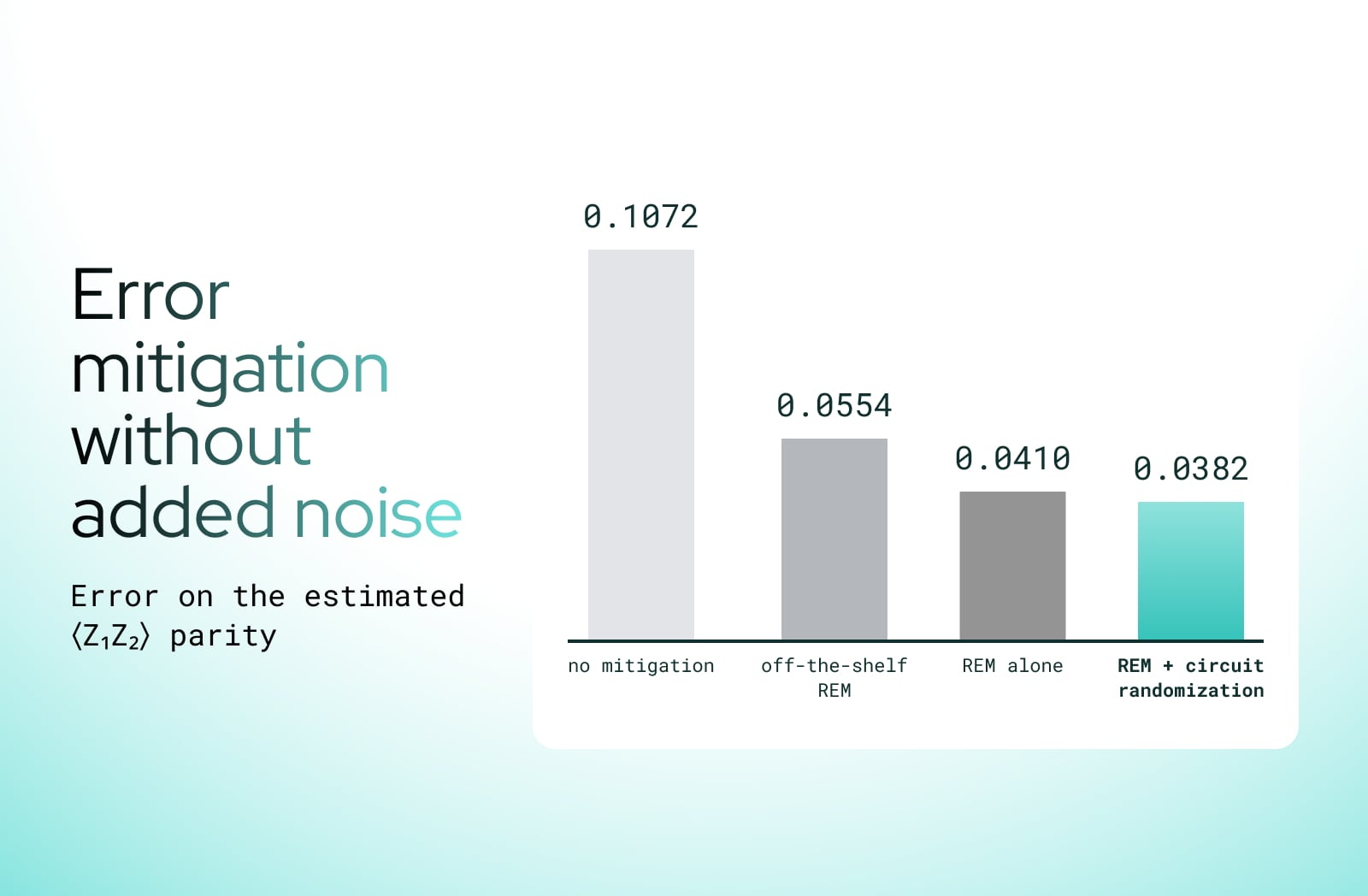
On a 10-qubit GHZ circuit on Garnet, error in the ⟨Z₁Z₂⟩ correlator from its ideal value of 1 dropped from 0.107 raw to 0.038 with our full mitigation (REM + randomization) applied. IQM’s readout error mitigation alone reached 0.041, while standard, off-the-shelf readout error mitigation on the same circuits only reached 0.055.
The two techniques, circuit randomization and readout error mitigation, work independently or together depending on where your circuit’s errors are coming from.
The default path is a single function call. Both techniques apply with sensible settings tuned to IQM hardware, and a researcher who wants better numbers gets them without first reading a paper on twirling schemes.
Everything under that default is exposed and configurable. You can run one technique without the other, adjust how characterization is performed, or set your own strategy for either method. Teams who already have an error reduction pipeline can drop in the pieces they need rather than replace what they have built.
This is the same choice behind IQM’s open architecture more broadly: give researchers and engineers genuine visibility into how their circuits compile and execute, rather than an API that abstracts the hardware away and asks you to trust the result. You can see exactly which circuits get sent to the quantum computer, and you can recover the raw, non-mitigated counts alongside the corrected ones to compare them side by side. Being open source carries the same idea further. The code performing the correction is there to read, and there is nothing about how it works that IQM keeps closed. If you want to build your own optimizations on top or integrate the library into a pipeline it was not written to anticipate, nothing here locks you out of doing that.
Dynamical decoupling protects qubits sitting idle while the rest of a circuit executes, inserting pulse sequences at compilation without any change to your code. Qubit selection reads current calibration data and picks the layout during transpilation, so a circuit runs on the qubits performing well today rather than the ones that performed well when a script was written. Calibration drifts, and readout error on a device can range from under one percent to nearly ten percent depending on which qubits you land on, so this is not a small effect. Circuit randomization and readout error mitigation sit on top of that same foundation, but they change what you can do with the result itself, not just what runs it.
That’s what Production Quantum means at the software layer. Owning a system is only half the story; owning what comes off it, being able to see exactly how a number was corrected and reproduce that correction yourself, is what turns a result into something you can build on. A researcher on IQM’s cloud computing platform gets that same guarantee as a team running a device on their own site. Nothing here is a black box you have to trust. It’s a result you can own.
Start here: the tutorial on IQM Academy walks through applying both techniques end to end. The documentation and source code are open to read before you install anything.

Emilia Stuart is a content strategist and storyteller at IQM Quantum Computers, specializing in translating complex quantum computing concepts into engaging narratives. With a background in research and tech marketing, she understands potential customers and crafts stories that resonate. Emilia’s passion is making intricate technologies accessible to diverse audiences.
Search faster—hit Enter instead of clicking.
Click to expand