

The project was financially supported by the Région Île-de-France under the Pack Quantique program. The results are published in Pareto-optimal quantum kernel selection for unsupervised anomaly detection on real malware beaconing data.
Quantum machine learning is one of the most active and debated areas of quantum computing research. A central question of the NISQ (Noisy Intermediate-Scale Quantum) era is whether there are practically relevant problems where a quantum approach can outperform classical machine learning. AQACYB set out to test this on a real cybersecurity problem.
Detecting anomalous, or malicious, behavior in network traffic is relevant across industries that need to strengthen their cybersecurity. In anomaly detection, labelled examples of malicious traffic are generally scarce. Detection models therefore often need to be unsupervised: they learn what normal traffic looks like and identify traffic that deviates from it. The study uses a fully unsupervised protocol for this reason.
The team used kernel methods, a well-known technique in classical machine learning with an established quantum counterpart, in combination with support vector machines. A kernel measures how similar two data points are. A quantum kernel encodes the data into a quantum circuit, which maps it from the input space into a higher-dimensional space, called the feature space, where the learning task becomes easier.
There are many possible quantum circuits for encoding the data, and many settings for each. To choose between them without labelled data, the team built an optimization framework that scores each quantum kernel on two measures at once:
Jointly optimizing how well the quantum kernel performs and how different it is from a classical kernel is the key idea of this study. A quantum kernel that performs well but is geometrically close to a classical one gives no reason to use a quantum computer. A kernel that is very different but performs poorly is of little practical use.
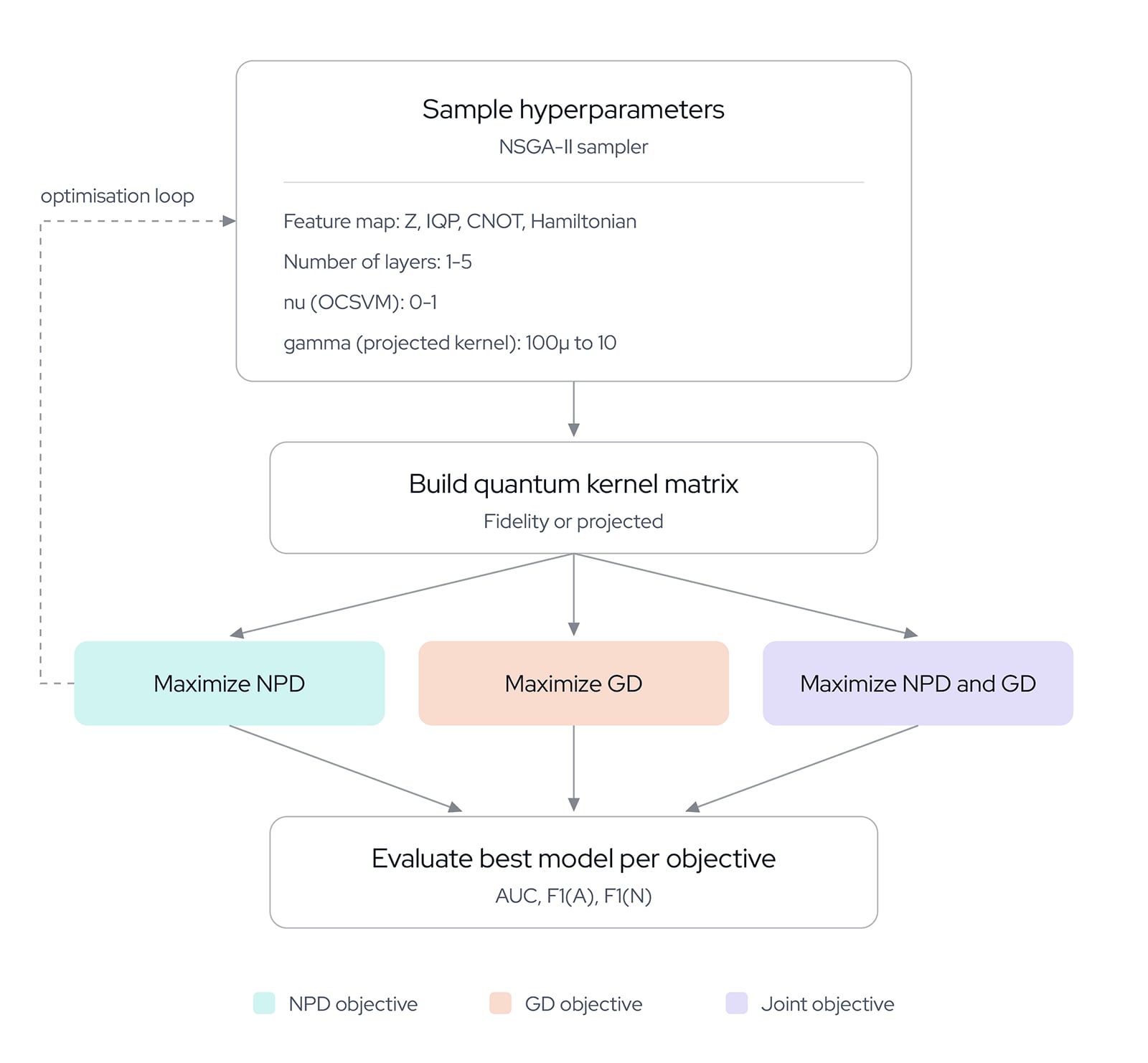
The optimization loop tests different quantum circuits and settings, scores each one on performance, geometric difference or both, and keeps the best model for each goal.
The team obtained results on the real malware beaconing data both in noiseless simulations and in experiments on IQM Garnet, a 20-qubit superconducting quantum processor. Pre-processing of the data reduced the number of features to six; the data were then subsampled to obtain a train set of size 200 and a test set with 1000 points, containing all the anomalies.
The results show why performance and geometry need to be considered together to draw conclusions about quantum advantage. In some noiseless configurations, quantum kernels performed better than the classical kernels tested. These kernels had a small geometric difference, however, which indicates that a different classical model could perform equally well. The team also found
quantum kernels with a large geometric difference, but these performed worse.
Noise on the hardware also reduced the performance of the quantum kernels. The effect was strongest when the optimization selected deeper data-encoding circuits with several two-qubit gates, which have larger errors.
On the dataset chosen, and with the quantum kernels considered in this study, the team found no quantum advantage. Whether quantum kernels will show an advantage on real-world applications remains an open question. The protocol developed in AQACYB gives a way to explore it: it tests, without labelled data, whether a quantum model is both accurate and meaningfully different from classical alternatives, and it can be applied to different data and use cases.
Future work will address the main limitations of the study: the limited amount of data used, the need for data-encoding circuits better informed by the use case, and error mitigation techniques tailored to the hardware to reduce the impact of noise.