It started with a challenge in a physics lab just outside Helsinki in 2018. A group of physicists from Aalto University and VTT kept running into the same wall: how do you scale a quantum computer, and can you do this from Europe?
Some problems, like modeling a molecule precisely enough to design a real drug, or mapping a material well enough to build a better battery, don’t get any easier on a supercomputer, even the most powerful ones we have. They get solvable on a machine built the way nature actually works: on a quantum computer. We had the ingredients to make that happen: good qubits, fast gates, thermal management. That was the whole pitch, really. It became IQM.
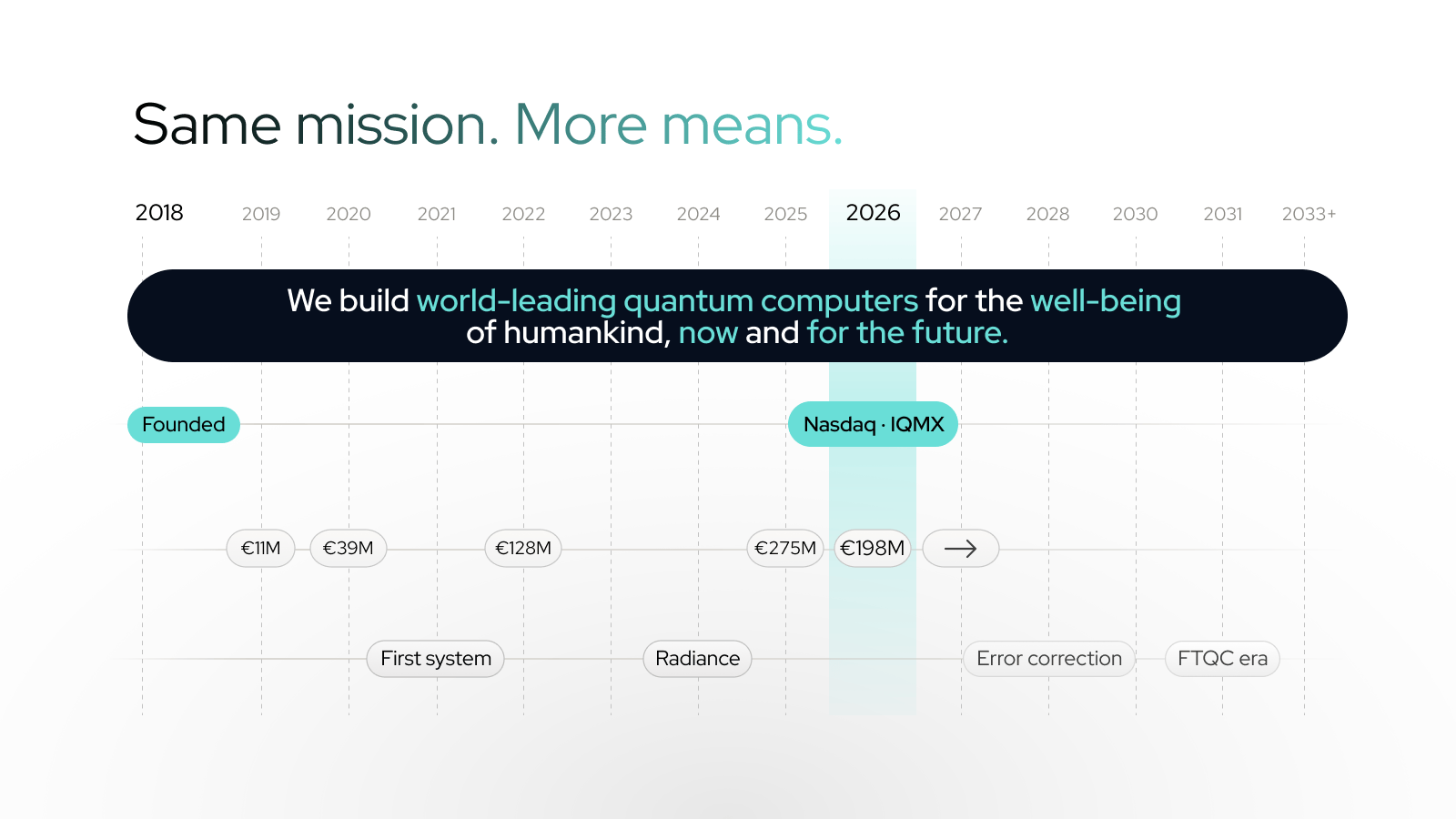
Two months ago we listed on Nasdaq, and on Nasdaq Helsinki a day later. The first European quantum computing company to go public and list on a major U.S. exchange. Ever since, people keep asking me the same two things: why did we do it, and what has changed?
What hasn’t changed: mission, purpose, and the ambition level
Our mission has not changed since 2018. We build world-leading quantum computers for the well-being of humankind, now and for the future. When we first developed this mission statement together with our early employees, it sounded lofty and maybe a bit grandiose for an early-stage startup from a small country in the Nordics. Now, after going public and raising much more capital, our mission feels like a plan. Aspiration is becoming intention with a clear strategy behind it. It is still the most ambitious thing I have ever attached my name to, but now, for the first time, it really feels achievable. Our mission is what holds us together, what gives us purpose.
Getting here was the reason a group of scientists walked away from comfortable academic posts to fabricate their own chips, build their own systems, write their own software, and connect them to applications. It helped us sell quantum computers our customers can actually own, operate, and build on. We give customers the control, security, and ability to enable ecosystems that would benefit the well-being of humankind. We are building a completely new industry that is here to stay. Similar to Moore´s law in semiconductor industry, we are expecting developments in quantum computing to continue. The roadmap and the ambition level have not changed, and they give the company direction and purpose.
That kind of ambition also does not run on venture timelines. It runs on decade timelines.
What has changed: the means to achieve our goals
The mission, purpose, and ambitious roadmap did not change with the listing; the means to achieve it all did. Going public strengthened our global positioning, our funding, and our operational ability to execute the roadmap.
Some of what changed since the listing is just procedure. Quarterly reporting, a live share price, a much bigger audience reading everything we publish. That is fine by me. It has made us more careful about what we are willing to put our name on, exactly as it should. That is how trust and reputation get built.
The bigger change is where the real contest sits now. For years the question hanging over all of us was whether any of this even works. More and more, the question is whether it can be built and deployed at the pace the world actually needs. That is a manufacturing and scaling problem at least as much as it is a physics one. Industrializing quantum computing, turning it into infrastructure that people run every day rather than a result in a paper, is where the next few years are won or lost. If we truly meant what we said about going after the hardest problems for the biggest payoff, then this is the fight we have to be in.
Why we did it: to lift the company to the next level
To achieve these goals, we raised more capital. But here is what we’d actually call the win: the capital came in at a valuation built on real commercial numbers rather than a story about the future, in a sector where sentiment has swung wildly for two years running. Through all this, a specific set of people — employees, existing and new investors — looked at the same uncertainty we did and backed us anyway. We also did our first M&A transaction to develop an application platform for our quantum computers. Driving consolidation was one of the motivations for going public.
Going public was a key enabler for the model we are building. It is straightforward to describe. Customers own their machines, operate them, and build on our platform, instead of renting time on somebody else’s. But a model like that only works if you can genuinely show up wherever a customer needs a system running and serviced. That has pulled us a long way past Finland, where all of this started. We now build and support systems across Europe, Asia, and the United States, including within the U.S. Department of Energy national laboratory system, with people from more than forty countries. That is simply what it takes to keep machines running on customer sites around the world. Being a global company listed on major stock exchanges definitely helped with this model.
Still the same challenge
The challenge today is still similar to what it was back in 2018: building better quantum computers than anyone else. The big difference is that a few hundred of the best industry experts are now working alongside us, and a great many more are watching to see how we progress. We have reached our milestones and have more ahead of us. And this will not change; we will keep developing better quantum computers, now and in the future. The technology will develop; the race is on. I like our odds.
Going public was a genuine milestone, and we celebrated it, and we celebrated the people who got us there. But in reality, our listing represents an important step forward rather than some kind of finish line. It is what allows us to achieve more breakthroughs and execute our roadmap. There is a version of this industry where these breakthroughs would happen somewhere else, and Europe would simply buy the finished product in large quantities a decade later. I never wanted to work inside that version. We set out to prove that we can build a global company out of Europe to lead the category instead of buying the technology from someone who got there first. Being public with a dual listing in New York and Helsinki is what lets us actually chase that now.
We have been brave with this ambition, and we will stay brave for the future!
Search faster—hit Enter instead of clicking.
Click to expand