
Most people imagine quantum computing as highly theoretical work.
For me, it often feels more like debugging.
A lot of the job is figuring out what is actually going wrong. You never really know if it’s a physics issue, a software issue, a hardware issue, or something else entirely. To solve problems efficiently, you need to understand the full system quite deeply.
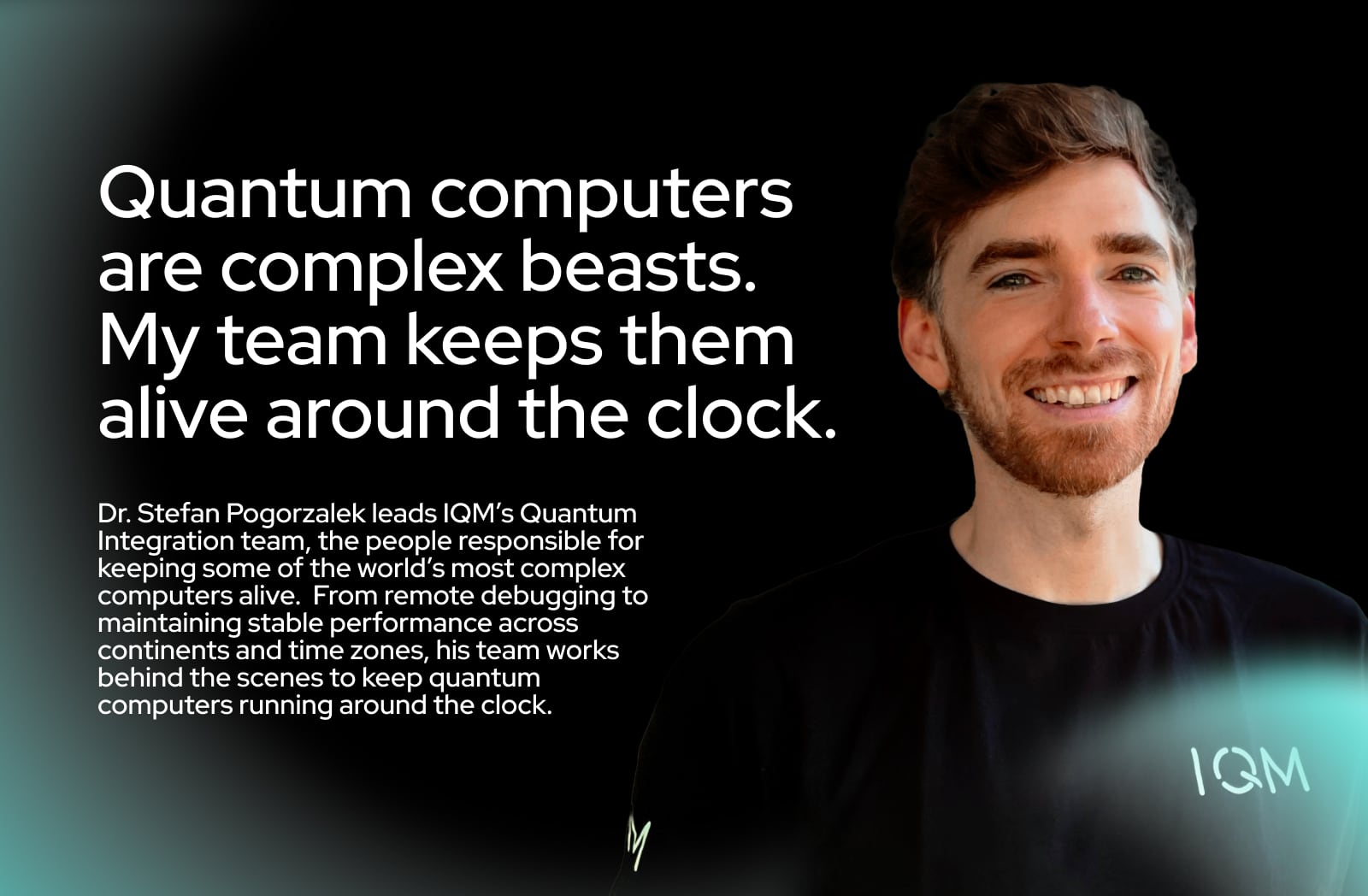
I’m a Team Lead in IQM’s service organization, where my team helps keep quantum computers operational, calibrated and usable for customers around the world. We sit somewhere between R&D, software, hardware, customer support and production systems.
We’re kind of in the middle of everything.
I studied physics at the Technical University of Munich, Germany. During my master’s degree and later my PhD, I worked with quantum communication experiments using superconducting circuits, technology closely related to what IQM uses today.
Problem-solving is my biggest motivation. The physics itself was interesting too, but understanding why something behaves differently than expected was always the more interesting part for me.
A lot of my time during the PhD was spent troubleshooting experiments, testing setups, and trying to make systems work reliably.
That turned out to be surprisingly good preparation for the quantum computing industry.
I joined IQM more than five years ago as the first experimentalist in the Munich office.
At the time, the company felt very different from today. Much smaller, much more chaotic, and very fast-moving. The attitude back then was mostly: let’s figure out how to make this work.
Today, my work is focused much more on production and customer systems. Our team’s main goal is to keep the systems operational and running as smoothly as possible.
In practice, that involves many different things.
We monitor systems, investigate issues, maintain calibrations, support users, and work closely with R&D teams whenever something behaves unexpectedly.

“A lot of times, we are the first team contacted if there is a problem with a quantum computer.”
The difficult part is that the root cause is rarely obvious in the beginning.
Problems can come from calibration, software, hardware or unexpected interactions between different parts of the stack.
To solve them, you need a fairly broad understanding of the system as a whole. We work closely with software teams, hardware teams, R&D, product management, and customer-facing teams almost daily.
Quantum computing is still a relatively new field, so if something breaks or behaves unexpectedly, there is a good chance nobody has seen exactly that issue before.
“You can’t really Google the solution.”
You need to investigate it yourself, run experiments, collect data, discuss with people and gradually narrow things down until you understand what is happening.
The pace is also very different from research-focused work. Instead of spending months investigating a single topic, the focus is often on solving issues efficiently and keeping systems stable for users.
The systems need to run.
That creates a very different engineering environment from pure R&D.
One thing that surprises people sometimes is that we rarely physically touch the systems ourselves.
Most of the work happens through diagnostics and experiments but every now and then, we have troubleshooting sessions together with people on-site while we control the systems from our computers.
Recently, we even had somebody livestreaming the lab environment using a phone mounted on their head while we guided the debugging process live.
That kind of collaboration is actually quite common.
One of the major challenges going forward is scalability.
Quantum computers are still very hands-on systems. A lot is already automated, including calibration procedures, but the machines remain sensitive and complex.
At the same time, IQM is deploying more and more quantum computers globally. As the installed base grows, so does the need for stable uptime, fast support, and efficient operations across multiple customer environments.
“Quantum computers do not stop running just because it is nighttime in Europe.”
This creates entirely new technical and operational challenges, especially when systems need to perform reliably across many customer environments worldwide.
That also means our team is growing quickly. We are expanding not only in Europe, but also across different time zones, including the US and Japan, with the goal of supporting customers around the clock.
One thing I appreciate about IQM is how collaborative the environment is.
If you don’t know something, you can simply ask. People are generally very willing to help and work together on problems.
That collaboration is necessary because the systems are too complex for isolated work.
My own team works very closely together as well. We discuss issues constantly, share ideas, and try to help each other whenever something unexpected appears.
Outside work, I mostly try to switch off through bouldering, or weekend bike trips and solving puzzles in escape rooms or at home. But I still enjoy coming back to my daily technical puzzles every day.
They just come with more qubits!