
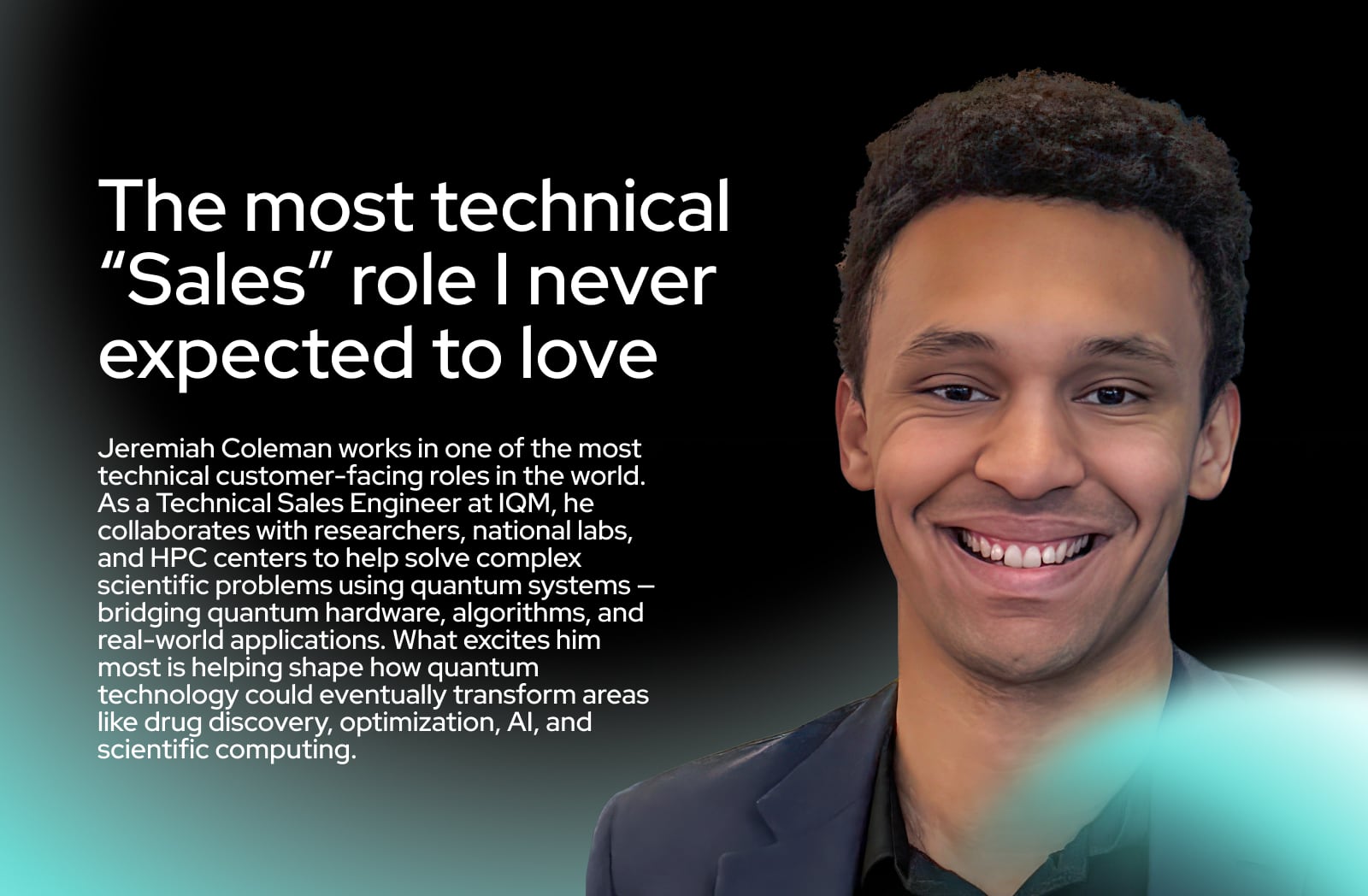
Jeremiah Coleman works in one of the most technical customer-facing roles in the world. As a Technical Sales Engineer at IQM, he collaborates with researchers, national labs, and HPC centers to help solve complex scientific problems using quantum systems — bridging quantum hardware, algorithms, and real-world applications. What excites him most is helping shape how quantum technology could eventually transform areas like drug discovery, optimization, AI, and scientific computing.
If you had asked me in high school what I wanted to work on, I probably would have said neuroscience.
I was fascinated by the brain, how consciousness works, how intelligence emerges, and how biological systems process information. Somewhere along the way, I came across a paper discussing the “quantum brain theory,” which proposed that quantum mechanics might somehow play a role in consciousness.
Looking back, the theory itself is probably far less convincing than I initially thought. But it introduced me to quantum physics, and that curiosity ended up completely changing the direction of my career.
I started studying engineering physics with a concentration in quantum information science and eventually became deeply interested in quantum technologies themselves, not only from a physics perspective, but also from the perspective of what these systems could eventually enable.
During undergrad, I helped found the Stanford Quantum Computing Association. One thing that became obvious to me very quickly was that quantum computing should not remain isolated within physics departments. Building a quantum system involves a diverse group beyond physicists including computer scientists, systems engineers, microwave engineers, cryogenic engineers, mechanical engineers, and many more. Further, the fields that will likely be impacted most by quantum technologies include chemistry, optimization, computer science, machine learning, and material science. This will require domain experts to join the quantum journey.
As President of Stanford Quantum Computing Association, a big motivation for me was making quantum computing feel more accessible and less mysterious for students outside traditional quantum physics backgrounds.
Later, during an internship at Google Quantum AI, I got exposure to the realities of building superconducting quantum systems. That experience was important because it showed me both how impressive and how difficult large-scale quantum computing actually is. I then worked with the Quantum Economic Development Consortium (QED-C) on an application oriented hardware agnostic quantum benchmarking platform. It is here where I understood the vast applications of quantum algorithms.
It is one thing to discuss quantum algorithms theoretically. It is another thing entirely to understand the hardware constraints, fabrication challenges, calibration complexity, and scaling limitations firsthand.
That eventually led me to Princeton, where I am currently a PhD candidate focused on superconducting quantum hardware.
My research training has largely centered around becoming what I would describe as a full-stack quantum hardware engineer: designing qubits, simulating them, fabricating them, measuring them, and understanding how all layers of the stack interact.
But over time, I realized I also wanted to move closer to the application side of quantum computing.
I wanted to better understand how people are actually trying to use these systems in the real world. What problems matter most? What limitations prevent adoption today? What kinds of workflows, software, and architectures are researchers and institutions actually looking for?
That is ultimately what brought me to IQM.
Today, I work as a Technical Sales Engineer and Customer Solutions Engineer for North America.
“The title can initially sound misleading because when people hear “sales,” they often imagine a traditional sales role. In reality, the work is deeply technical.”
Most of my day involves understanding customer research goals, reading papers, discussing architectures, debugging workflows, evaluating algorithms, or helping institutions determine how quantum systems fit into their broader HPC and research environments.
Our customers range from national laboratories and supercomputing centers to research groups, professors, PhD students, and industry researchers. Many are exploring hybrid quantum-classical workflows, error correction research, pulse-level control, compilation strategies, or integration with existing HPC infrastructure.
“One thing I enjoy most about the role is that it sits across multiple layers of the quantum stack simultaneously.”
On a given day, I might be discussing hardware limitations with technology teams internally, helping a customer think through a new quantum workflow, researching emerging applications, writing technical responses, or collaborating with product teams on future capabilities.
There is a huge amount of context switching, which I personally enjoy because it constantly forces me to learn.
I also think working customer-facing has fundamentally changed how I think about quantum systems.
When you interact directly with researchers and institutions trying to solve real problems, you gain a much clearer understanding of where quantum technologies are genuinely useful, where current limitations exist, and what capabilities people actually need next.
Those conversations become extremely valuable for shaping future systems.
Another aspect I appreciate about IQM is how collaborative the environment is.
Because the field itself is evolving so quickly, communication across teams becomes critical. I regularly interact with product teams, software experts, hardware researchers, HPC specialists, business teams, and marketing — all while trying to align technical capabilities with practical use cases.
The culture feels very close-knit and fast-moving, especially within the US team. Everyone is highly technical, highly collaborative, and motivated by the same broader mission: helping make useful quantum computing systems a reality.
What keeps me excited about the field overall is the long-term potential of quantum technologies.
Applications in chemistry simulation, drug discovery, optimization, sensing, cryptography, machine learning, and materials science all have the potential to fundamentally reshape industries if these systems continue advancing.
Even beyond individual applications, quantum computing represents something bigger to me: a large-scale scientific and engineering challenge that requires expertise from many disciplines working together.
Fifteen years ago, many people viewed practical quantum computing as unrealistic. Today, we are watching physicists, engineers, computer scientists, mathematicians, and researchers collectively push the field forward in ways that once seemed impossible.
Being part of that effort — even in a small way — is what motivates me most.
Search faster—hit Enter instead of clicking.
Click to expand